Showing posts with label Fantasy. Show all posts

Wednesday, June 8, 2011

Midnight in Paris (2011)

An absolute delight for romantics, the latest Woody Allen picture concerns a hack screenwriter who, while on vacation in Paris, begins to take nightly walks through the streets in search of inspiration. What happens on these walks, an element graciously ignored by the majority of the promotional materials, I would not dare to spoil; what I can reveal is that the film is a meditation on the nature of art and art worship, in relation to the writer's deep, age-old reverence of the city of lights and the plethora of early 20th-century thinkers who made it their nesting ground. Owen Wilson plays the lead with a delicate balance between the typical Allen doppelganger and his usual shlubby, take-it-as-it-comes demeanor; it is nothing we have ever seen from Wilson or an Allen lead, and it is his career-best lead performance. Needless to say, considering this is a Woody Allen film, the cast is exemplary; aside from Wilson, Rachel McAdams, Tom Hiddleston, Michael Sheen, Kurt Fuller, Adrien Brody, Kathy Bates, and Marion Cotillard all show up with terrific results, especially McAdams, Cotillard, and Brody's sly, winning cameo. There is the usual romantic difficulties, revolving around differences in intellectual values and careless infidelity, sure, but the greater concern of the film is something more elusive and unconventional, and that is the ideal state for the creative mind. This sort of subject matter is rather exclusive and, dare I say, intellectual for most audiences, but for those who can appreciate the literary and artistic references, the dry, dense dialogue, and the devoutly romantic portrayal of Paris, the film creates a distinct mood and sense of joy that, I suspect, will not be found in any other American film this Summer.

Highly Recommended for fans of Allen, romantics, and junkies for early-20th century art and literature such as Picasso, Hemingway, or Cole Porter (whose "Let's Do It" plays a prominent role). I was fairly certain Whatever Works was going to be the last great film from Mr. Allen; upon leaving the theater, I could not remember the last time I was so happy to be so wrong.

Thursday, June 2, 2011

The Last Airbender (2010)

I have to admit, I didn't really watch the film with its original production audio, but rather with the custom Rifftrax audio commentary that the Mystery Science Theater 3000 guys made for this one. That being said, while the viewing experience was hilarious, self-aware, and more accessible, the film itself struck me as a humorless adaptation of the animated series, with beloved characters rendered into lame caricatures and plot points, along with a painfully dull, first-of-a-trilogy plotline. I cannot give this turd a full review. But I can wholeheartedly recommend watching it with the Rifftrax in place, where the plethora of shortcomings, misconceptions, and shoddy performances become not detriments to the film, but rather its glorious, epic-fail signature. For those who actually followed the series devoutly, and expected more from a big-budget Hollywood adaptation, I am sad to say, it's just not there; from the annoying reductions of the three leads to the impotent flailings of villainous Dev Patel, there is very little here to appreciate with any sort of sincerity. The effects, my biggest hope for the production since the original teaser on last year's Super Bowl, are, surprisingly, repetitive and unremarkable, and do nothing to expand what has been seen in the promotions. I made a decision, years ago, that the strengths of The Sixth Sense, Unbreakable, and even Signs, made M. Night Shymalan worth defending, or at least, worth holding out hope for; why does he actively keep making it harder for me?

W/ Rifftrax: Recommended for fans of campy, overreaching fantasy/sci-fi such as Flash Gordon or Dune.

http://www.rifftrax.com/rifftrax/last-airbender

W/out Rifftrax: Skip it.

Kung Fu Panda 2 (2011)

Fun, but blatant and obvious, this animated sequel has the titular panda, Po, joining forces with the legendary "Furious Five" to prevent an explosive-launching peacock from conquering China. My main issue with the first movie, namely the lack of actual screentime with the Furious Five (wasting voice talents like David Cross, Lucy Liu, and Jackie friggin' Chan is pretty lame), is inherently addressed in this one; the film is, essentially, a "men on a mission" movie, with Po and the Five fighting baddies together for the bulk of the film. And in that sense, it totally works, moving energetically from set piece to set piece, while taking the time to slow down and let the characters round themselves out into more than merely figures of Po's id. This entry also expands on the relationship between Po and his adopted father, marvelously voiced by MR. DAVID LO PAN (James Hong), achieving some poignant, if obvious, moments with them by the film's end. The baddie, a sinister, insecure peacock voiced by Gary Oldman, is appropriately menacing and engaging, although not up to the viciously evil standards set by Ian Mcshane's panther character from KFP 1. While it can be easily dismissed as lazy, hammy work, Jack Black slips into this role like a glove; it optimally utilizes his energetic, childish vigor without ever hinting at his more subversive, stoner-y tendencies (which, I should mention, fellow cast member Seth Rogen can never mask). The rest of the cast is rounded out by Angelina Jolie, Danny McBride, Dustin Hoffman (whose role is sadly truncated here), and Jean-Claude Van Damme (!!!), all of whom are appropriately invisible and engaged.

My biggest gripe with the film remains, expectedly, the way it deals with its ancient Chinese backdrop. For every sweet, killer idea they introduce (the various members of the Furious Five use the fighting styles of their corresponding animals), they subvert it with something juvenile, inappropriate, and obvious (Po shoving as many steaming buns into his mouth as possible). The whole tone of the film has taken a step into the wrong direction, making more accessible for, not only younger audiences, but more international ones as well; babies and China haters alike can dig this movie. The wuxia elements of the film are too-often relegated to backgrounds and costumes, rather than motifs or mood; even the Furious Five's fight scenes are often abbreviated and, unsurprisingly, focused on Po. The recurring theme of Po finding his "inner peace" comes off as very simplistic and unremarkable given the excellent spiritual wisdom relayed to Po (and his master) by the wise, late turtle character in the original. And relegating Dustin Hoffman's wise (rat) master to little more than a bookending cameo is (such as the near-deletion of Hoffman from Little Fockers) a tragic error in judgement, with his snarky, deadpan musings remaining just as crucial to the franchise as Po's excessive girth. However, although it is not up to par with the original, or (clearly) anything Pixar has made (since Cars), KFP 2 is definitely a fun, family-friendly flick that will probably not depress the parents that must watch it with their kids instead of seeing The Hangover Part II.

Recommended to fans of the original or of the more adventurous, engaging Dreamworks flicks like How to Train Your Dragon or Megamind (which features a superior turn by David Cross). It is slight, quick-paced, and funny; for many audiences, what more could you ask for?

Monday, May 23, 2011

Cabin Boy (1994)

Simultaneously inventive and consciously (and gratingly) corny, this semi-entry in the long-line of mid-90's attempts at making movie stars out of SNL cast members tells of an educated "fancy lad" who is forced to act as a cabin boy for a crew of scraggly fishermen. The ex-SNL'er, in this case, is Chris Elliot, who, to be fair, was better known for his work with David Letterman (who exec. produces and cameos here) when this film was released. His lack of an established comic persona (other than his patented delivery and clearly outside-the-box sensibilities) hurts his ability to mount a successful comedy vehicle, and, more often than not, his dimwit protagonist just comes off as a screenwriter's contrivance than anything organic or naturally funny. His love interest, an aspiring world-class swimmer played by Melora Walters, feels shoehorned in and forced, and the normally talented Walters flails around in search of a spark of energy to inject into her scenes. And, worst of all, the plot is almost completely nonexistent; other than a failed attempt at giving the cabin boy a self-actualization character arc (please), there are no real narrative throughlines, and the structure ends up resembling something like a half-assed SNL Odyssey sketch.

All of this is kind of a shame, because this Tim Burton-produced endeavor actually has some really great, interesting touches that end up making it somewhat watchable. For one, while the lead and his romantic interest are lame ducks, the supporting cast is near-perfect: as the grizzled seamen, Brion James, Brian-Doyle Murray, and, most of all, James Gammon are wonderfully savvy and over-the-top in their well-worn, tried-and-true sea dog personas. Considering the majority of the film takes place on a tiny, obviously falsified fishing boat, their efforts do miles to establish the sea-adventure tone of the film. Also appearing in hilarious cameos are Ricki Lake, Mike Starr, Andy Richter (as the even dumber original cabin boy), and, funniest of all, Letterman (billed as Earl Hofert) as a curmudgeon who, intentionally, sabotages cabin boy's voyage home to his parents. Other than the lame, poorly rendered ship, itself, the special effects in the film have a whimsical, George Melies-influenced quality that is refreshingly lo-fi and original: clouds have faces in them that blow in the direction of the wind, a man-shark creature is merely Dr. Jacoby from Twin Peaks with a fin strapped to his back, and the six-armed, blue-skinned sex goddess and her giant husband are rendered with merely blue-paint, puppetry, and in-camera tricks, like forced perspective. If the writing (and budget) had lived up to the conceptualization on display, this could be remembered as a fantastical anecdote to the more grounded, family oriented comedies of the time period (see: Billy Madison, Tommy Boy). Unfortunately, as is, it remains as, merely, an interesting curiosity, and a progress note of Elliot's talents at this point in his career (final verdict? Not there yet).

Slightly Recommended for fans of Elliot, or of a more surreal brand of mainstream comedy (Land of the Lost and Your Highness are vague spiritual approximations). This one is best enjoyed with lowered expectations; knowing that, going in, should prove for a fairly entertaining, mildly diverting experience.

Wednesday, May 18, 2011

Pirates of the Caribbean: On Stranger Tides (2011)

Simultaneously inoffensively fun and thoroughly lightweight and forgettable, this fourth entry in the Pirates franchise disregards previous leads Will and Elizabeth, and instead focuses on Jack Sparrow as he ventures in search of The Fountain of Youth. I use the term "focuses" lightly; while the central narrative actually does involve Captain Jack this time, he is merely a cog in a larger machine that also includes a haunted ship, run by the legendary Blackbeard and his daughter, a Spanish fleet en route to desecrate the Fountain for Catholicism, and the British Navy, led by a tenuously reformed Captain Barbossa. Jack drunkenly blunders his way in and around these elements, flirting with Blackbeard's daughter (who is, in a lame and obvious twist, a former flame), and fighting alongside Barbossa, leading up to the final showdown at the Fountain of Youth. If the plot seems telegraphed and obvious, that's because it is; eschewing the complicated narrative overlapping of the last two films, the writers have created a streamlined scenario with clear-cut conflicts and tensions, without very much in the way of subtlety or subtext. This both works for and against this chapter, for while the lack of pretension and heavy-handedness allows one to further enjoy both the gorgeous production design and Jack's humorous demeanor, the obvious lack of substance or any memorable, distinctive moments can be directly attributed to that decision. However, where the script fails is where the crew pick up the pace, creating lovely, detailed environments (aside from the anticlimactic Fountain, itself) that are lensed and rendered beautifully, hampered only by the restricted staging and lifeless action scenes (save for the introductory London setpiece) that can be attributed to inexperienced (and overrated) director Rob Marshall.

Another huge problem with deviating completely from the preexisting formula, and cast, of the series is the necessity to shoehorn in a new collection of characters to rival the originals. For the most part, this leads to undeveloped, undercooked, and generally uninteresting roles like Ian MacShane's Blackbeard (a tired mad pirate caricature), his daughter (an indifferent Penelope Cruz, whose entire character is encapsulated by a reference to her "fiery blood from her Latin mother"), a stowaway priest (a clearly contrived substitute for Orlando Bloom), his mermaid love interest (a clearly contrived substitute for Keira Knightley), and a lame, barely-seen captain of the Spanish fleet (a central villain with maybe 5 lines). Faring better amongst the new blood are Scrum, yet another entry in the series collection of grizzled crewmen, who, as played by Stephen Graham, is hilarious, endearing, and more of a presence than any of the glorified extras who swabbed the decks before him, and Richard Griffiths, who absolutely kills it in a cameo as King George. But, even more evident here than in At World's End, the secret weapon of this franchise remains not Johnny Depp, who has a jolly time while not bringing anything new to the table, but rather Geoffrey Rush as Barbossa. His long face, his bulging eyes, his epic line delivery, and, while posing as a good, stalwart Englishman, his splotchily dyed skin and pathetic wig all fit perfectly well into this pirate universe, and his exuberant presence, as in the third one, goes a long way into legitimizing the "piracy" of the film. By the time him and Jack were tentatively teaming up against the Spaniards, I was more on board with the franchise than I had been since the finale of Curse of the Black Pearl, and for a while, the film really allows these two characters to optimally utilize their well-worn characters for an ideal sense of breezy, humorous adventure. His contribution to the franchise, and, especially, to this film in particular, cannot be overstated; he, rather than the Keith Richards impersonation (or Richards, himself, who cameos again), is the true image of a Pirate at the heart of this world, so much so that Blackbeard, with all his supernatural fire and brimstone, just comes off as a bad Xerox of Rush's character.

Slightly Recommended for family audiences, people who really liked the previous entries of the franchise, or for action fans who have already seen Thor and Fast Five (I'd even see Fast Five again, and did, before this one). This was not nearly the disaster I had predicted it to be; time will only tell whether it survives the dissipation of its audience by one adventure-fantasy, one sweat-covered male actioner, and a unanimously approved chick flick, all of which are superior films.

Saturday, May 14, 2011

True Legend (2011)

A badass, throwback Wuxia film, this Chinese kung fu saga tells the story of Su, a war hero who suffers the consequences of handing to his adopted brother, a bitter, venom-poisoned sociopath, his rightful governorship. The opening of the film is an elaborate mountain-set battle scene establishing Su as a stalwart, capable warrior. The initial melodrama moves along quickly; within 20 or so minutes, Su has risen and fallen as a hero, his villainous step-brother has already declared his intentions, and the stakes (the step-brother is in custody of Su's son) are established. Broken and deprived of the use of his right arm, Su heals in the mountains with his wife (and a holy doctor, played by Michelle Yeoh) until he is confronted by The God Of Wushu, a mystical figure who taunts him and assures him that until he can conquer him in battle, he will not be ready for his step-brother. It is here that the story becomes slightly more complex; rather than being a straight-forward wuxia revenge flick, this is just as much about Su conquering his own demons as it is about beating up bad guys. The narrative takes its time to get to its climax, and when you think the film is about to end, it has another chapter, about the West's corrupting influence in the region, that deviates from the rest of the film. However, the central theme of Su living up to his potential, and disregarding his fears, longings, and insecurities to be the best warrior (and father) he can be.

The cast is dedicated, effective, and in tune with the material; the flippant, "I have somewhere else to be" attitude of some Shaw Bros. actors is nowhere to be seen here. Vincent Zhao, as Su, goes through several remarkable character changes, and handles them, both physically and emotionally, with aplomb. Andy On is despicable and terrifying as the villainous step-brother; his physical prowess and shocking training methods keep the tension and forward momentum of the narrative going for a large chunk of the film. In smaller roles, Michelle Yeoh, Jay Chou (as the God of Wushu), and a certain late, great Western martial arts figure (who, singlehandedly, saves the last 20 minutes of the film) add a degree of class and pedigree to what could, on the surface, be easily dismissed as a throwaway kung-fu import. The other key element that separates this from your average Eastern beat-'em-up is the spectacular fighting choreography. Director Yuen Woo Ping's name is synonymous with large-scale, balletic kung-fu; aside from his legendary directorial credits, like Drunken Master, and my personal favorite, Iron Monkey, he provided the choreography for flicks like Kill Bill, The Matrix, Crouching Tiger, Hidden Dragon, Fist of Legend, Kung Fu Hustle, and Once Upon A Time in China. He brings his legendary expertise here, with a plethora of fights that come fast and furious like Dom Toretto, each one crucially different than the last. Andy On's 5 venom fist, in particular, is a scary and awe-inspiring delight. The story is strong, and holds up (until the end), but the dynamic fighting is what makes this film occasionally pop off the screen and transcend into something signature and memorable.

Recommended for fans of large-scale Wuxia flicks like Iron Monkey or Fearless. I do not know if it contains enough universal appeal to crossover to western audiences (the crowd I saw it with seemed unsure of how to react, with genuine applause and inappropriate ironic laughter being expressed equally), but I certainly found it to be a remarkable, graciously old-school Wuxia tale.

P.S. This movie is shot REALLY well for any film, let alone an action flick. The skies, mountains, and sets of this movie are fantastic, and will tickle any of the photographically inclined who end up seeing it.

Wednesday, May 11, 2011

Drive Angry (2011)

A surprisingly fun, self-aware enterprise, this relentlessly aggressive throwback to '70s car flicks such as Vanishing Point revolves around a near-psychopath as he attempts to rescue his kidnapped granddaughter from murderous satanists. The film never gets too much more complicated than that; aside from a couple of other characters, such as a beleaguered waitress and a mysterious "Accountant" in pursuit, the narrative is almost solely tied into the protagonist's quest for his missing granddaughter. The race-against-the-clock aspect, along with the cult aspect, reeks of '70s exploitation, and the film is definitely in that mold, eschewing logic for impact at any given moment. However, unlike similar exercises in action meta-awareness (like Shoot 'Em Up), this one actually knows where to draw its goofy/serious battle lines, with the slower moments having just as much dirty, grimey, pulpy energy as when it's at its most kinetic. That is not to say the action is not up to snuff; bullets fly at the screen, sex is rampant, and, for a film of this budget, the car stunts are surprisingly large-scale and well-rendered. And the cast, not an Ocean's 11 ensemble by any means, is wonderfully game.

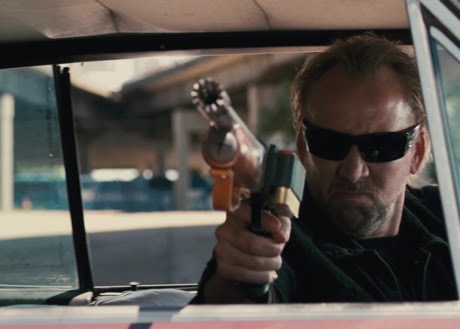
I had read, prior to seeing the film, that Nic Cage plays against his strengths in this, going for a "Man With No Name" vibe, as opposed to his own patented explosivity; I call bullshit on that. While he is not screaming "It's murder! MURDER! And you're all guilty! GUILTY!!!", he is definitely aware of the silliness of the production, and takes his character to various extremes, but never condescends to the material; if I had to guess, I'd say this and Kick-Ass were more the kind of work he'd like to be doing than Sorcerer's Apprentice and Season of the Witch. As his waitress cohort and co-lead, Amber Heard is vicious, vivacious, and all sorts of awesome, giving this role a decent amount of humanity, and never once seeming like a desperate wannabe starlet running away from pyrotechnics. She has consistently turned in strong work in all that I've seen her in, but if she plays her cards right, Heard could easily make a career as a tough action heroine, sexier than Michelle Rodriguez and more fiery than Angelina Jolie. Billy Burke (who I recognized from Jane Austen's Mafia) is an effectively eerie villain, and David Morse shows up in an extended cameo as a friend of Cage, but the real highlight of the acting department is William Fichtner. Instantly recognizable, but elusively eclectic, Fichtner all but steals the film as the Accountant, seemingly toying with everybody in the film; neither a hero, nor a true villain, his character exists only to toy with civilians and to increase the stakes for Cage, both of which he does with a great sense of relish that I hope to see more of from the talented actor. He really has established himself as a modern day Warren Oates, or Elisha Cook, Jr., killing it in talented directors' work without ever worrying about being typecast or overexposed (remember his opening scene in Dark Knight?).

Highly Recommended for anyone who thinks that they'd like a movie called Drive Angry 3D starring Nicolas Cage and Amber Heard. Or for anyone who has ever said to themselves, "You know? They really don't make 'em like Vanishing Point anymore." I have. And they did.

Wednesday, May 4, 2011

Thor (2011)

Ambitious, inventive, and ultimately satisfying, this oddball superhero movie revolves around the titular God of Thunder as he is cast down from his native realm Asgard (read: Valhalla meets Mt. Olympus) for betraying his father, Odin's, command. After a brief, gratefully grounding introduction in New Mexico, much of the first act of the film takes place in regal, vaguely viking yet strikingly foreign Asgard. The film's greatest achievement is in its realization of Asgard; its self-contained history, its architecture, its science, and its methods of transportation are all given a fair amount of attention, which, in this day and age of assembly-line studio tentpoles, is a real blessing, and gives the Asgard sequences a sense of wonder and delight. Once Thor arrives on Earth, the film naturally deflates a little bit; after a dynamite, eye-opening first act, Natalie Portman's astrophysicist, SHIELD's slow, already-seen discovery of Thor's lost hammer, and the obvious fish-out-of-water Thor vs. contemporary New Mexico comedy deflate the pic around its midsection a bit. However, as his villainous brother, Loki, makes his political stand for Thor's rightful place on the throne of Asgard, the film gains its momentum and, while never quite reaching the apex of the opening scenes, leads to a satisfying, surprisingly convincing climactic showdown.

I must say, I had doubts over the previously-untested skills of Chris Hemsworth as Thor, but they were thoroughly unfounded; while he is going to have to work to keep up with Avengers teammates Robert Downey, Jr. and Chris Evans in the charisma department, he looks the part (much to my girlfriend's delight), he fights very convincingly (for someone formerly on Australia's Dancing with the Stars), and, most importantly, takes this stuff very seriously, that is to say he knows when to act regally haughty AND when to relax in the role a little. Among those backing him up on Asgard are Ray Stevenson, Idris Elba, and Rene Russo (as his mother), all of whom are appropriately tough, decadent, and Norse (Elba's badass gatekeeper character is a personal favorite). Anthony Hopkins is, surprisingly, effective and non-campy as the wise, tough Odin, and Tom Hiddleston makes for a complicated, volatile Loki, a stark contrast from Thor's stalwart beefcake. Inevitably, the human characters get the short end of the stick: Natalie Portman's Jane Foster is underwritten and goofy, Kat Dennings is essentially reduced to making one-liners about Thor's hot body and weird demeanor, and poor Stellan Skarsgard, clearly one of the more talented and experienced actors in the film, relegated to spouting out whatever benign dialogue the plotline saddles him with. None of them are ever even exposed to Asgard, keeping their realm of experience, and thus their interest quotient, to a minimum. However, as members of Shield, Clark Gregg is, once again, absolutely hilarious and deadpan as Agent Coulson, and Jeremy Renner makes a cameo as a certain Marvel character whose appearance is, at the same time, mercifully brief and perfectly integrated (his introductory shot elicited cheers from me and maybe a handful of other wise audience members).

Kenneth Brangah has never directed a film of this magnitude, the closest being his remake of Frankenstein, but, as with Favreau's Iron Man, you'd never tell based on his work here. Aside from the perfectly realized and rendered Asgard, with the rich, unconventional iconography, the rip-roaring action scenes, the large-scale effects sequences, and his interesting, canted angle-heavy shot compositions, he more than steps up to the plate of this grand style of filmmaking. In many cases, his bravery is commendable; there are not many contemporary directors of big-budget comic book flicks who would have had the chutzpah to dress Ray Stevenson the way he looks here (and he sure looks great drinking and gnawing on bones in a banquet hall). The old-world dialogue is concise, and rings true, marking a decided contrast with the Natalie Portman- and Kat Dennings-speak, and the interplay between Thor and the humans is far less corny and obvious as it could've been. However, the latter contains some of the least intriguing moments of the film, and, without the magnetism of, say, Tony and Pepper Potts' scenes in the Iron Mans, keep the film from attaining the modern classic status of Favreau's original masterwork.

Recommended to fans of the source material, the current generation of Marvel-sanctioned flicks, or of high-scale, big-budget sci-fi fantasy such as David Lynch's Dune, 1980's Flash Gordon, or The Chronicles of Riddick. This is above the level of The Incredible Hulk and Iron Man 2, yet not quite to the level of the original Iron Man; it is yet to be seen whether this or Captain America will be the better-remembered of this year's Avengers flicks (alls I know is, Marvel will have enough footage for a teaser by the time late-July rolls around, so...definitely ready for that).

Wednesday, April 13, 2011

Death Note II: The Last Note (2006)

The sequel to 2006's live-action manga adaptation, this entry tells the contuining story of Light, who uses the Death Note to kill whomever he wishes by merely writing their name within its pages, and L, the gifted, intuitive cyberdetective obsessed with uncovering his identity. Without ruining the last film, the ending implied that there would be a sort of team-up between the two characters, and this film largely revolves around the implications of that partnership, from both sides. While L is nearly certain that Light is the enigmatic "Kira," as he is known, he is continuously thwarted by Light's ability to use the constituents of the book to his advantage. Meanwhile, the rest of the world reacts, in various ways, to Kira's unrelenting presence in the media, along with the arrival of, what seems like, another Death Note into the hands of another "Kira."

As it is more directly bound by plot and specific characters than the last installment, this follow-up is not quite as thematically ambitious as its predecessor, and does not focus on the societal impact of Kira's actions as much as their effect on the familiar characters from part 1, and two crucial new female characters. Where the last one played with the viewer's emotions in regards to Light, and how he simultaneously expressed empathy and ruthlessness through the Death note, this one paints the characters in broader strokes, and makes less of an effort to keep their motivations behind their actions ambiguous. However, in exchange, there is more an emphasis on immediacy and suspense, and, after a full movie setting up the duel between L and Light, it is a blast to see their rivalry take center stage while the global ramifications of the Death Note pile up around them. The fundamental differences in their characters are more highlighted this time around, and their strained, yet somewhat understanding interplay is the main joy of the film. Also along for the ride, with further extrapolation, are Light's police official father, his apple-eating guardian god-of-death, Ryuk, and L's loyal handler, Watari; one of the advantages of the two films being filmed with such little time-lapsed is that not only is the entire cast present, but everyone looks and acts exactly as they should, considering the plot begins mere moments after the original's ending.

Highly Recommended for fans of the original, or of ambitious, morally ambiguous manga or cinema. I was not as taken off guard with this one as I was with the first one, but that is only due to my lack of awareness of the series prior to that viewing; in terms of sequels, I kept waiting for this one to show the dirt under its fingernails from playing in its own playground for too long, but the film managed to ride the momentum provided by the original until its thoroughly satisfying wallop of an ending.

Wednesday, April 6, 2011

Sucker Punch (2011)

Simultaneously over-ambitious and hideously involving, this girl-power flick tells, in metaphor, the story of a group of female mental patients and their attempts to escape, both spiritually and physically. After we are given the opening titles on a stage, as if setting up a musical, the ace opening tells us, without words, how the protagonist, "Baby-Doll," got herself incarcerated by assaulting her scheming, money-hungry caretaker. Once arrived at the mental hospital, she almost immediately reverts into a sort of trauma-induced hypnosis, where in her perception, the hospital is a brothel, her fellow patients are beleaguered prozzies, and the teeth-gnashing caretaker is a reptilian, pencil-moustached pimp. Revealing much else would betray the wild, intercontextual nature of the script, and the various, dare-I-say-it, sucker punches the film provides throughout. What I can say is that there is yet another level of reality the film sinks into, and, without a set of false, loosely followed rules (*ahem*, Inception), the visuals of these fantasies are allowed to be, well, just as crazy as what you've seen in the films' promotional materials. While much of the more lavish and mind-blowing visuals are contained solely in the characters' minds, they manage to incorporate enough of the main plotline to be more than mere distractions in what is, otherwise, an intimate, introspective tale. The performances of the main girls are hit-and-miss, with Jena Malone's Rockit faring the best (her energy is infectious, whether dispensing dialogue, or dispensing asskicking) and Vanessa Hudgens, surprisingly enough (heh, heh), embarrassing herself, and looking like she'd much rather be on the set of Beastly. Carla Gugino, with her comic-book lips and physique, is perfectly cast as the resident "Madam," Oscar Isaac is a thoroughly hissable villain, and, best of all, Scott Glenn reminds everyone how truly awesome Scott Glenn can be with his pseudo-Jiminy Cricket musings ("And one more thing…").
As grateful as I was for all of director and co-writer Zack Snyder's risk taking, as well as the unabashedly FLAWLESS integration of special effects and live-action, the film did not end up coming together into perfection the way that I had hoped for. I have done a great job of keeping spoilers off of Righteous Film, and I refuse to end that for the sake of attacking the decisions made in the film's third-act, but I must call to attention the striking similarities between the ending of this film and that of a certain futuristic spoof of bureaucracy (saying which would kinda ruin it). That crib, along with several other decisions make the ending feel like a sort of acknowledgement of the films stylized, inorganic nature, which would be fine, had that been the film's only goal. However, there are lengthy scenes, with substance, that serve only to invest the viewer's emotion in the plotline, the circumstances, and the characters, and the style-over-substance ending seems to undermine these more powerful, merciless moments. Had the ending lived up to the promise of those earlier SUCKER PUNCHES (the title, if you haven't guessed, is quite apt), the film would probably be the best film of Snyder's career, and the template for a new era in action-oriented fantasy. But alas, as is, the whole thing suffers Snyder's recurring lack of cohesion in his films (save for the director's cut of Watchmen), and the movie is best enjoyed as, simply, a movie, and nothing more. Which is a shame, because the successes of this movie are beyond mere moments; it achieves a certain flexibility in its tone and structure that few films try and pull off, and even fewer films actually achieve. Maybe the originally cast lead, Amanda Seyfried, would have been the missing link to the movie that is and the movie that could be, but as is, we are left with a fascinating, yet flawed (I think I already see the problems his Superman movie will have) drama-fantasy-sci-fi-actioner.

Recommended (despite its flaws) to fans of outside-the-box sensationalism (i.e. Sin City), Zack Snyder, and GIRLS!! Seriously, hearing that the majority of the films audience have, so far, been male was a disappointment, because this is easily one of the more empowering female-centric action films I've seen in recent memory. But I guess that repeatedly shagging Ashton Kutcher, Jake Gyllenhaal, or Justin Timberlake without the threat of a long-term relationship is all the escapist fantasy that the current generation of young females need.

Saturday, February 19, 2011

Death Note (2006)

Bleak, serio-comic Japanese film about a young man who comes into possession of a book that has the power to kill any living person on earth by merely writing their name down in it. The protagonist (if you can call him that), Light, is an average teen who finds the book in a dumpster, and is immediately descended upon by a creature named Ryuk, who identifies himself as the previous owner of the book. He explains the rules to Light, and acts as sort of a guardian angel, only without the angel part; he is more of a sounding board for Light's ideas than a conscience. Initially well-meaning and focusing only on nationally known criminals, his antics with the book become so nefarious and undeniably supernatural that a force begins to oppose him, led by the police and an ominous force named L who communicates through a surrogate and a computer. The moral and practical implications and pressures of what he is doing begin to take their toll on Light, and he descends into a pragmatic madness to justify his use of the book.

The film is based on a Manga, and it is evident by the structure of the plot; even more so than Akira, this feels like a perfectly compiled "Greatest Hits" of a larger, more overarching story. Light is a very complicated protagonist, and his issues are certainly not resolved by the films end, enticing me to next seek out the films sequel. His relationships with his girlfriend, his father and, later, L, are layered and real, way above most western portrayals of dark, haunted teens. Him and Ryuk, his Jiminy Cricket, have a uniquely personal interplay that makes one easily forgive the so-so computer animation of his character; neither being a saint, they talk of morality and responsibility in vague terms, aware of goodness but never fully compliant to it. The whole film has a moralist edge that conflicts with the pseudo-nihilism of the characters, and it works in the films favor, creating a world where ethics are impotent without power, while achieving power corrupts ones ethics.

Highly Recommended for fans of gritty Japanese morality tales a la Battle Royale. As I have not read this or any other manga, I cannot refer to how it compares to the final film, but I've heard from friends that the Death Note manga is overdrawn, melodramatic, and superficial, none of which I would say about the cinematic adaptation.

Your Highness (2011)

Laugh-out-loud, ambitious fantasy-comedy about a pair of medieval-era princes, one handsome and stalwart, the other a Kenny Powers-esque slob and philistine, who team up to save the handsome one's bride from an evil wizard. Along the way, they get involved with many genre-appropriate side-quests and obstacles, eventually forming a bond with a female warrior who, inevitably, is the philistine's love interest. The true innovation of this movie is a reappropriation of the tone of 2001's A Knight's Tale, with it's amalgam of era-appropriate and anachronistic dialogue and circumstances, just done to the umpteenth degree; while some scenes are riddled with "thines" and "thous," in one of my favorite moments, the handsome prince reacts to news of the female warrior's joining of their party with a genuine, "Nice!" However, to counteract the fantasy stuff, the first hour (prior to the addition of Natalie Portman's badass chica) has a very strong buddy comedy element, with the two princes having a strained, yet bro-y relationship that recalls David Gordon Green's last film, Pineapple Express; separating the two for third-act tension is the film's most crucial flaw, along with the lack of a payoff a la the brilliant "I'm gonna save you, man" scene in the latter film. The fantasy stuff is very cool, and played surprisingly straight, with some pretty inventive and creative scenarios and creatures, but the ending promises a more spectacular display of magic and wizardry than it ultimately delivers on. Ultimately, the film achieves a tone not unlike Land of the Lost, where, while there are genuinely cool things going on, the true essence of the film is defined through its comedy and its tongue-in-cheek tone.

While I figured, prior to seeing the film, that Danny McBride would kill it as what is essentially a dark age-era Kenny Powers, cussing, womanizing, and abusing drugs with an intense, thoroughly intent vigor, it is James Franco, as the foppy heir to their fathers throne, who ends up standing out. Investing his character with a different sort of sexual and behavioral naivete than his character from Pineapple Express, he smiles, poses, and sings (terribly) through the film without once taking his character too far into the realm of the obnoxious superstar role; he has true love for his brother, and actually respects him for not succumbing to the superficial, castrating pressures of the royal court and their father. However, about an hour or so in, he joins his love interest (a surprisingly funny, but disappointingly sparse Zooey Deschanel) in captivity, and Natalie Portman permanently joins McBride to defeat the evil wizard and save the two lovers. Here, without the constant verbal interplay of Franco and McBride, the film begins taking itself too seriously, and several unnecessary plot elements begin to develop, before faltering and being forgotten about. While the action in the final showdown IS big, and only slightly anticlimactic, it is not dynamic or interesting enough to cover for the decided lack of laughs in that section of the film. That being said, the rest of the film balances its tone nicely, with Charles Dance, Damian Lewis, and Toby Jones (well, maybe not Toby Jones) adding a touch of gravity and dimension to the proceedings, but it only barely survives the cliched, lazy plotting the film eventually succumbs to. And Natalie Portman, skivvies or no, is having a tremendously overexposed year, with Black Swan, No Strings Attached, The Other Woman, Thor, and this all opening within THE FIRST 6 MONTHS of 2011. Her familiar, and boringly Episode 1-ish appearance in the film deflates much of the momentum from the films sails, and the successive beats that work function despite, and not at all in due to, her presence.

Recommended to fans of goofily epic and large sci-fi/fantasy films, a la Land of the Lost, or Judd Apatow buddy comedies, like the aforementioned Pineapple Express. There are a number of potsmoking references and scenes, but this is not the stoner comedy its title would lead you to believe; way more Krull than Cheech and Chong.

P.S. Justin Thereoux may be slightly too cutesy and self-aware as the evil wizard, but he gets some INCREDIBLE moments and lines, such as the already iconic response to the King's, "And how do you expect to do that?": "Magic...motherfucker!!"

Thursday, January 27, 2011

Heavenly Creatures (1994)

Fanciful, dark retelling of the true story of two young girls in New Zealand who insulate themselves in their own, private world, with disastrous results. Melanie Lynskey is Pauline, who is lower-middle class and repressed by her conservative mother and the remnants of various illnesses that plagued her as a child. She meets Kate Winslet's Juliet as a transfer student from England; similarly disease-ridden in her youth, she constantly escapes reality via immersive flights of fancy, i.e. pretending to be royalty in some far away land. Pauline is immediately attracted to Juliet, and the two begin to take Juliet's world of make-believe to the next level, with a wide array of fictional characters, kingdoms, and enemies, that relate to the real world only in the loosest sense. Eventually, their respective parents take issue with how close the girls proceed to get, and attempt to take measures to separate the two, turning them against their families. Their fake world has no tolerance for the meddling ways of real life, and so, they proceed to take whatever steps they see neccessary to stay together, using their false representation of reality as validation.

Kate Winslet and Melanie Lynskey are both given "Introducing..." credits here, and they instantly show the qualities that have led both of them to further success in film. Winslet is a strong, magnetic presence, pretty but not beautiful, comfortable without being showy. She is inspires both empathy for her misery, and sympathy for her delusional misappropriations of reality. Lynskey is given the harder role of being both inspired by Winslet and entranced by her; once familiar with Juliet's constant presence, the idea of being alone again is so frightening to Pauline, it sours her innocence and purity, so Lynskey must project both sympathy and insecure malice, which she does successfully without betraying the realism of the portrayal. She is, ostensibly, the lead of the piece, which gives writer/director Peter Jackson the difficult task of making you relate to her, which, thankfully, he succeeds in doing. Jackson, and cowriter Fran Walsh, relate the troubles of Pauline to Juliet to more conventional teenage struggles in such a way that I, as someone who was most certainly never a teenage girl in conservative 1950's New Zealand, could directly empathize with the two beleaguered youths. The increasingly lavish visualizations of the girls' fantasies ends up bringing about the Jackson we know and love, with computer-effects portraying their terracotta kingdom as being filled with lively, animated figures; while I prefer The Frighteners overall, as a film, this one has the more convincing special effects (odd, for of the two, it was the one NOT produced by Universal). Without spoiling anything, the tonal shifts of the piece are jarring, but Jackson handles the whole endeavor very well so that it feels like a uniform, singular piece, and not merely a collection of poignant, intense scenes.

Highly Recommended for fans of Peter Jackson, Kate Winslet, Melanie Lynskey, or real, friendship-based teen dramas. I was expecting something decidedly more chicky and exclusive than what I got; Jackson still has, in my eyes, an immaculate record (although I still haven't seen Bad Taste or The Lovely Bones).

Saturday, January 22, 2011

Fantasia 2000 (1999)

Weak, but ambitious follow-up to the 1941 Walt Disney classic presenting several animated vignettes set to immediately recognizable, iconic classical music. While the essential elements of Fantasia have been transplanted here, somewhere between the obviousness of the music (only Ave Maria and The Nutcracker Suite were as universally familiar as the choices here), the rotating star introductions (Steve Martin, ok, but Bette Midler, Penn and Teller, and Quincy Jones?), and the thin nature of the stories themselves (i.e., Donald Duck as Noah building his ark), the classiness, energy, and profundity of the original are lost in this installment. Only one segment, a tribute to New York set to Gershwin's "Rhapsody in Blue," brings anything new and interesting to the proceedings, for the '41 Fantasia did not concern itself with urbanity and modern civilization. Even with the tune and animation heavily evoking Woody Allen's Manhattan, the jaunty, stylized animation provides a depiction of New York City that manages to be truly signature and exciting. If one or two of the other pieces managed to impress as much as the Gershwin segment, this would have been a thoroughly worthwhile and rewatchable endeavor. As is, it exists as merely a pale tribute to Walt Disney's original ambition of a continuing series of abstract, elemental animated films set to classical music.

Skip it, save for the following segment.

Tuesday, January 11, 2011

Nothing Lasts Forever (1984)

A surreal, thoroughly original comedy about a young man who goes to New York City to make it as an artist, only to discover that the Port Authority has hijacked the city into a repressive, function-oriented dystopia. Zach Galligan from Gremlins plays the lead, an amiable, fresh-faced small-towner who is determined unfit to be an artist, and is forced to work the tollbooth at the Holland Tunnel. He attempts to break through the art world by proxy, only to find it is a dense, insular subculture where absurdism is mistaken for poignancy, and superficiality dominates. Eventually, he discovers a society of divinely-wise homeless people, and is tasked with saving the moon. Oh, and the entire film is presented, in style and tone, like a Frank Capra film from the '40s.

The film was written and directed by Tom Schiller, who contributed many short films to SNL over the years, and this film is somewhat in the style of his more bizarre, surreal work for that program. Although clearly well-versed in classic Hollywood, Schiller is not content with merely aping the era, but rather using it to portray his bizarre story in a way that carefully treads the line between camp and sincerity. If the film was an empty excercise in style, it would not warrant a feature film, but Schiller and Galligan provide enough genuine, irony-free substance that the narrative is simultaneously completely silly and thoroughly engaging. There is a climactic musical number by Bad Santa's Lauren Tom that achieves an obscure, fragile poignancy that very few films of the era evoked, especially the mainstream comedies. The presence of Dan Aykroyd and another classic SNL alum (he's credited, but I refuse to specify who due to the perfection of his opening moments) ensures some familiar, straight-laced comedy, but mostly, the laughs are in the sheer absurdism of Schiller's storytelling methods and 1940's sensibilities. It is a fantastical, dreamlike film, and warrants a greater appreciation than it currently receives from academia (though that is most likely due to its lack of DVD availability).

Highly Recommended for fans of more original, anarchic comedy, or of old 1970's SNL. The film can be seen here, or can be downloaded off of a VHS copy on Bittorrent. There is genuinely nothing quite like this movie; a true lost classic.

Thursday, August 19, 2010

Scott Pilgrim vs. The World (2010)

Hipster trash about an unemployed 22 year old who falls in love with a girl who, he discovers, has seven evil ex-boyfriends who will fight him to the death for her honor. Michael Cera is poorly cast in this film; right off the bat, we discover Scott has a 17 year old girlfriend (they "held hands for a sec, but she got uncomfortable") that he is using to get over his own ex, but who is completely in love with him and his shitty garage rock band. He leads her along and drops her when the real love story of the film (with the girl with the psycho exes), making him kind of an ineffectual asshole before the film has even gotten going. If he had been played by someone with a little more range or edge, it would be easier to dismiss his transgression as post-relationship trauma, but his apparent awareness and lack of sincerity make him fairly unlikable right from the get go. The love interest, Ramona Flowers, is also quite worthless, never exhibiting any qualities that would be worth fighting anyone for, let alone crazy psycho powerful superhero exes; as he fights for her, she continually dismisses and ignores him, making one wonder why Scott is as willing as he is to fight for a girl who may or may not care about him. The whole emotional core of the movie is empty and stupid, which is a real shame because Edgar Wright actually scores major aesthetic points here with his filmmaking methods.

There is narrative text throughout, random video game elements relating to the story, and crazy, larger-than-life, Stephen Chow-esque battle sequences. It is all really cool stuff you can stuff in a trailer, but when in the context of this film, it is loud, hollow, and pointless. The characters are not amicable enough for the audience to root for them, and the emotional situations are plodding and uninteresting. The leads, and Cera's rock band posse of friends, are contrived and unlikable, and are basically hodgepodges of other characters from other movies (the freckled angsty drummer is a third name away from being Mary Stuart Masterson in Some Kind of Wonderful). The only actors who come out of this film looking good are Chris Evans, Brandon Routh (as two of the more heinous, infamous exes), and, surprisingly, Kieran Culkin as Scott's snarky gay roommate, who shares his bed with Scott AND whatever conquests he brings home, much to Scott's chagrin; it is a huge detriment to the film that Culkin, the most likable character, does not throw down at any point to back up his best friend. However, the moments where the fights actually break out are typically fun and exciting, particularly the ones with the two aforementioned actors (Routh has a killer sense of timing and delivery, and Evans has the funniest moments in the film with his over-the-top movie star routine). And it was definitely cool to see a bad guy burst into coins after being defeated just like a goombah in Mario, until, like most of the interesting concepts in the film, it is repeated at face value (but NEVER explored) to the point that noone is allowed to oversee how friggin COOL the film is trying to be (and it's not.)

Slightly Recommended to hipsters and video game junkies. This is Edgar Wright's first film that is not a masterpiece (Shaun of the Dead and Hot Fuzz will still get play on my TV for many years). Once again this year, I find myself dismissing a film with one constant, unswaying mantra repeating in my head: "KICK ASS WAS BETTER!"

Monday, February 22, 2010

Hot Tub Time Machine (2010)

Hilarious, if somewhat obvious comedy about 3 40ish guys, and one of their nephews, as they travel back in time to their mid-80's prime via, you guessed it, a Hot Tub Time Machine. My expectation was that the 80's setting would be the primary source of humor, given the obvious anachronisms and culture shifts since then, but the 80's jokes are mostly comprised of time-appropriate references and obvious fashion jokes. John Cusack, Rob Corddry, Craig Robinson, and Clark Duke play the 4 leads, and their interplay ends up being the draw of the film, more so than the absurdity of the plot and situations. Corddry, in particular, really surprised me with his tragi-comic performance as the guy who really felt at home in the '80s, and was never able to live up to his hedonist heights as a teenager. I can already tell Clark Duke will be pigeonholed as the next Jonah Hill, due to his hipster frame (both body and specs hehe), but I find his humor much more interesting and realistic; he does not seem like he's trying too hard to make us laugh, but at the same time, understands the humor of his character and demeanor and utilizes it well. Craig Robinson and Cusack are dependably g, but I have rarely been disappointed, so I was not surprised. Collette Wolfe, of The Foot Fist Way and Observe and Report, deserves a mention for her sexed-up 80s blonde, who happens to be the young version of Clark Duke's mom, much to his chagrin.

When I heard that John Cusack was going to star in a '80s nostalgia piece involving a ski resort, I had hoped for a more provocative, more retrospective look at the differences between then and today; what would Lane Meyer be like 20 years later? But the fish-out-of-water plot remains too derivative and obvious to allow for any insight to seep through. What we do get are excellently devised gags and undeniably electric chemistry that make the energy and hilarity of the film more than satisfactory. I had just hoped for a script with a little more balls and a little less corniness and contrivance than this, but I can settle for one where the friends interrupt one of their own mid-coitus, then allow him to finish to maintain the space-time continuum.

Highly Recommended for fans of the cast, goofy studio comedies, and '80s movies a la Better Off Dead. This was funnier than I expected, but not as ingenius as that first teaser made it seem...which I'll embed, just because it alone had me completely jonesed for this movie.


The Hot Tub Time Machine - Red Band Trailer
Uploaded by ThePlaylist. - Watch feature films and entire TV shows.

Tuesday, February 16, 2010

Powder (1995)

Corny, melodramatic turd about a telekinetic albino teenager that changes the lives of several small-town Texas folk. Sean Patrick Flanery (yes, Connor MacManus) plays the titular Powder, nicknamed such for his chalk-white skin, who has an undefinable relationship with electricity due to his mother being struck by lightning on the night of his birth. He is discovered after the grandparents that raised him die, and is taken in by sympathetic shrink Mary Steenburgen and ornery sheriff Lance Henriksen, both as wasted as an anorexic's dinner. He enrolls in high school, providing us with some terribly cliched mid-90's outcast teen drama. It is there where he meets the only person who understands him, a physics teacher played by Jeff Goldblum, who is the only actor not on autopilot; some of his line-readings were so humorous, it made it worse just to be reminded how tepid the movie that surrounded him was. Bullying, crying, and special-effect reaction shots persist, and the movie ends on a pathetic note with several main characters crying in a field. The real tragedy of the film is Flanery's performance. There is little in his demeanor or speech to suggest the vanity of a cover boy that he, ostensibly, was at the time. However, he remains a very good-looking, and physically comfortable lad, and no amount of white make-up, visible inner turmoil, or sympathetic gestures can hide that. He is trapped by a script that relegates him to a cliched, Rain Man-esque savant, but he is not able to immerse himself fully enough to the role for us to want to dredge through the snow to get to the cabin. Perhaps the film would've played better with a more freaky, unknown actor in the lead, but who knows; as is, Goldblum's the best actor of the bunch.

Skip it, save for Sean Patrick Flanery fans who wanna see the guy look like a Stranger from Dark City. Personally, I'd take Boondock 2 again, even with his fucked up face.

Saturday, January 9, 2010

Sky Captain and the World of Tomorrow (2004)

Fun throwback to the serials of the 1930s and, more obviously, a great showcase for then-modern digital compositing and greenscreen technology. Gwenyth Paltrow plays Polly Perkins (if you are already turned off, avoid this film), a spright New York reporter who stumbles on a nefarious plot to destroy the world. Jude Law is Joe Sullivan, a.k.a. the titular Sky Captain, Polly's ex who happens to be mankinds last hope at saving the day. Considering they spent most of their time running around in front of a green screen, their chemistry is what holds up interest in the film and, luckily, it works. Gwenyth displays the eye-rolling cynicism that got her a similar gig in Iron Man, and Jude Law actually shows some reserve for once; it could've been his most smiley role ever, but luckily, he keeps the cheekiness to a relative minimum. The rest of the cast is serviceable, with Giovanni Ribisi and Omid Djalili as reliable sidekicks to "Cap," as they call him, and late cameos by Anjelina Jolie (worthless, but her lips are among the films most impressive effects) and, in a very nice touch, fucking Lawrence Olivier. Again, if that last bit turned you off, avoid this film, but it evokes the time period like a motherfucker.

The story of the film is cute, but sometimes its thinness catches up with it, and you are left to wonder why you are watching this crazy fuckin thing. But then one of the many charming moments occurs, and you remember that, while it is light as air, this is a successfully entertaining film, and, surprisingly, the script is strong enough to warrant the effects budget. In the trailers, I thought the weird white sheen on all the surfaces would turn me off, but the visuals all work well in the finished product; very evocative, interesting work.

Recommended to fans of old school cinema (a la Indiana Jones), effects junkies, and those who dig movies that open with flying robots invading New York and lasering the shit out of everything.

Monday, December 28, 2009

The Imaginarium of Doctor Parnassus (2009)

Crazy return to form for Terry Gilliam, recalling his fantastical roots, albeit now with an more mature, reflective edge. The movie is not a Monty Python-esque romp through the whimsical and the divine; there are dark themes at play here, and long sequences of bleak, real world drama. It is nevertheless entertaining and playful, just not in the court jester mode Gilliam used to emulate. His obsession with dreams and recreating them on film reaches their absolute heights here, with CGI sequences that rival anything, in scale and impact, in Avatar. The story is captivating and thoroughly layered, warranting multiple viewings to truly grasp the impact of the characters' imagination in the film...hard to explain further.

Heath is wicked...he was firing on all pistons at this point in his career (sigh). However, he's not the star. The whole caravan, including Verne Troyer and Andrew Garfield in strong turns, is highlighted in an ensemble fashion, but the protagonist is, ostensibly, Christopher Plummer's Dr. Parnassus. His battle with Mr. Nick (or Satan, as played by Tom Waits...as good as it sounds) is at the heart of the film, and the changes and decisions he undergoes are the strongest and most varied of the characters. Plummer is an O.G., and General Chang certainly Von Trapps the shit out of the performance...he mumbles, drinks, and raves more than Dumbledore ever did, but he still manages to seem completely weathered and wise.

Highly Recommended for fans of off-kilter fantasy and/or Terry Gilliam's work. Ledger fans will be disappointed by his lack of display in the film (as will those of Johnny Depp, Jude Law, and Colin Farell), and Plummer fans are probably too old to read this blog. I rate it above Time Bandits and about the same as The Adventures of Baron Munchausen (if Gilliam tops Brazil or Holy Grail, I'll probably just drop acid and marathon his films Tarantino style for a few years).