Showing posts with label Comedy. Show all posts

Friday, June 17, 2011

Friends With Benefits (2011)

Tawdry, one-note, and cheesetastic to the point of inducing heart congestion, this rom-com is a remake of No Strings Attached...meaning it's yet another movie about two "emotionally unavailable" young professionals, one a prospective editor for GQ, the other a corporate headhunter, who decide to maintain a purely sexual, romance-free relationship. The two wildly successful, beautiful, and, mostly, well-behaved yuppies are played by Justin Timberlake and Mila Kunis, which should already clue you in to the standards of this movie. Have you ever seen either of them in public appearances? Then you are already familiar with their characters in the film, save for some arbitrary quirks for each party (nearly dyslexic math skills and a juvenile tendency to trespass simply for a "cool view"). The real con of the film is that the two leads, contrary to the title, are NOT REALLY FRIENDS. They meet about 5 minutes into the movie, and there is not very much time passed (maybe a couple of weeks) before they start doing bedroom gymnastics, with friend-exclusive comforts like Justin's mid-coital Semisonic renditions and Mila's lack of body image issues, because hey, if he's just my friend what do I care if he sees me naked (I'd say Mila's problems are more that she sounds remarkably like Meg Griffin, but that's just me)? They have an unproven relationship as platonic friends, so there is absolutely no tension as to whether these two young, fit studs are going to segue their immediate chemistry into a relationship. But a tentative, molasses-slow romance isn't what you're there to see, is it?

Too bad the laughs are barely there, the romance, corny and contrived, and the chemistry between the two leads amounts to nothing more than two hot-at-the-moment stars trying to maintain their stage personas, as well as their sex appeal. There are sex scenes, but they are over-the-top and played solely for laughs (there is nudity, but only of the rear end variety and, in Kunis' case, probably a stand-in). The dialogue that attempts to sound like hip, contemporary young people talking could've very well just been written by your average 20-something professional with its complete lack of subtext, subtlety, and originality (instead of the writers giving the girl a flamboyantly gay best friend, it's Timberlake who bonds with the homosexual who says things like "I never take the ferry...unless it's to a dinner and a movie!"). The only sparks the film achieves is due to its supporting cast, which includes Richard Jenkins, Jenna Elfman, Patricia Clarkson, and Woody Harrelson as the aformentioned "gay buddy" (who, to be fair, scores the biggest laughs in the film). While it is painful to watch such talented people walk on and recite arbitrary, unremarkable dialogue and exposition, in tandem with the walk-ons by Jason Segal, Emma Stone, Rashida Jones, Andy Samberg, and others, they provide the only moments of humor or energy to be found in this lifeless endeavor (Segal and Jones' hyper-romanticized film-within-a-film is clumsy and obvious, but they make it somewhat work). The other attempts at bridging the gap between broad, female-centric behavioral humor and its half-assed post-modern meta-awareness of its rom-com trappings fail miserably, and the two leads flounder around trying to cut vulnerable, identifiable figures out of flat, unrealistically perfect, and painfully stupid characters.

Skip It, save for women who want to have an estrogen-fest with a friend (please don't drag your poor male date to this unless he asks, in which case I hope he's trying to leverage the "casual sex" angle of the film into something a little more practical), as well as those who absolutely need to see these two cavorting in their skivvies for a good amount of screentime.

Wednesday, June 8, 2011

Midnight in Paris (2011)

An absolute delight for romantics, the latest Woody Allen picture concerns a hack screenwriter who, while on vacation in Paris, begins to take nightly walks through the streets in search of inspiration. What happens on these walks, an element graciously ignored by the majority of the promotional materials, I would not dare to spoil; what I can reveal is that the film is a meditation on the nature of art and art worship, in relation to the writer's deep, age-old reverence of the city of lights and the plethora of early 20th-century thinkers who made it their nesting ground. Owen Wilson plays the lead with a delicate balance between the typical Allen doppelganger and his usual shlubby, take-it-as-it-comes demeanor; it is nothing we have ever seen from Wilson or an Allen lead, and it is his career-best lead performance. Needless to say, considering this is a Woody Allen film, the cast is exemplary; aside from Wilson, Rachel McAdams, Tom Hiddleston, Michael Sheen, Kurt Fuller, Adrien Brody, Kathy Bates, and Marion Cotillard all show up with terrific results, especially McAdams, Cotillard, and Brody's sly, winning cameo. There is the usual romantic difficulties, revolving around differences in intellectual values and careless infidelity, sure, but the greater concern of the film is something more elusive and unconventional, and that is the ideal state for the creative mind. This sort of subject matter is rather exclusive and, dare I say, intellectual for most audiences, but for those who can appreciate the literary and artistic references, the dry, dense dialogue, and the devoutly romantic portrayal of Paris, the film creates a distinct mood and sense of joy that, I suspect, will not be found in any other American film this Summer.

Highly Recommended for fans of Allen, romantics, and junkies for early-20th century art and literature such as Picasso, Hemingway, or Cole Porter (whose "Let's Do It" plays a prominent role). I was fairly certain Whatever Works was going to be the last great film from Mr. Allen; upon leaving the theater, I could not remember the last time I was so happy to be so wrong.

Monday, June 6, 2011

Dave (1993)

Lightweight, moderately entertaining Capra-esque comedy about a shlubby presidential impersonator who, when the actual Commander in Chief has a mid-coital stroke, gleefully takes his place. The impersonator, Dave, is actually a full-time council worker who, predictably, is on the opposite end of the moral spectrum from the president's education-cutting, duplicitous administration. After the president is incapacitated, his power-hungry Secretary of State and a formerly idealistic advisor, played by Frank Langella and Kevin Dunn, respectively, immediately send the VP on a tour of Africa, while educating Dave in the ways and traditions of the Oval Office. While Dave initially goes along with them, making the rounds and giving their speeches, a meeting with his local friend and accountant (played by Charles Grodin), where he figures out how to "fix the books," inspires him to repackage the government or, at least, his administration. This catches the attention of his estranged, Hilary-Clinton-esque First Lady, played by Sigourney Weaver, and the purity and goodwill of the nation begin to take a backseat to White House balcony flirting and blind idealism.

When I say the film is Capra-esque, I do not just mean its "Mr. Smith Goes to Washington"-lite plotline; the dialogue, the performances, even the portrayal of the White House are all bathed in an anachronistic, hopeful light. While it differentiates the film from similar, more realistic portrayals of the White House, such as Aaron Sorkin's The American President and The West Wing, it also renders the film rather aimless and rudimentary; rather than deal with any contemporary political issues, Dave talks a lot about "returning" to "a good, strong America" without ever proposing how that is, practically, possible. The Capra-esqueness also extends to its cast; Weaver, Langella, Dunn, Grodin, a late appearance by Ben Kingsley, and, especially, Kevin Kline as Dave, all being pros, let the cornier aspects of the film dictate their performance, and find an ideal kismit with the material that overshadows its glaringly obvious plot holes (which I don't need to mention; this film's about a normal guy SUCCESSFULLY pretending to be the president). Ivan Reitman, amidst a run of family-friendly studio comedies that included Twins, Kindergarten Cop, and Junior (guess what: he's in this one too *hint, hint*), actually achieves a delicate balence between our realistic associations with contemporary Washington D.C. and the uber-hopeful tone of the script, and creates a political environment we can comfortably observe, if not truly believe in. In the end, while the forced love story and the hilariously broad portrait of the political system take their tolls, the film remains a cute, charmingly optimistic comedy with some great, professional performances (particularly from Kline, the delightfully and expectedly dry Grodin, and Dunn).

Recommended to fans of Frank Capra's political comedies and mid-90's studio-comedy optimism. I was pleasantly surprised at the cohesion and consistency of this film; a braver, less family-friendly draft of the script might have made for a marvelous update of pre-WWII cinematic idealism, but what is there is sufficient for a successful Kevin Kline comedy of errors.

Thursday, June 2, 2011

The Hangover Part II (2011)

This summary is not available. Please click here to view the post.

Kung Fu Panda 2 (2011)

Fun, but blatant and obvious, this animated sequel has the titular panda, Po, joining forces with the legendary "Furious Five" to prevent an explosive-launching peacock from conquering China. My main issue with the first movie, namely the lack of actual screentime with the Furious Five (wasting voice talents like David Cross, Lucy Liu, and Jackie friggin' Chan is pretty lame), is inherently addressed in this one; the film is, essentially, a "men on a mission" movie, with Po and the Five fighting baddies together for the bulk of the film. And in that sense, it totally works, moving energetically from set piece to set piece, while taking the time to slow down and let the characters round themselves out into more than merely figures of Po's id. This entry also expands on the relationship between Po and his adopted father, marvelously voiced by MR. DAVID LO PAN (James Hong), achieving some poignant, if obvious, moments with them by the film's end. The baddie, a sinister, insecure peacock voiced by Gary Oldman, is appropriately menacing and engaging, although not up to the viciously evil standards set by Ian Mcshane's panther character from KFP 1. While it can be easily dismissed as lazy, hammy work, Jack Black slips into this role like a glove; it optimally utilizes his energetic, childish vigor without ever hinting at his more subversive, stoner-y tendencies (which, I should mention, fellow cast member Seth Rogen can never mask). The rest of the cast is rounded out by Angelina Jolie, Danny McBride, Dustin Hoffman (whose role is sadly truncated here), and Jean-Claude Van Damme (!!!), all of whom are appropriately invisible and engaged.

My biggest gripe with the film remains, expectedly, the way it deals with its ancient Chinese backdrop. For every sweet, killer idea they introduce (the various members of the Furious Five use the fighting styles of their corresponding animals), they subvert it with something juvenile, inappropriate, and obvious (Po shoving as many steaming buns into his mouth as possible). The whole tone of the film has taken a step into the wrong direction, making more accessible for, not only younger audiences, but more international ones as well; babies and China haters alike can dig this movie. The wuxia elements of the film are too-often relegated to backgrounds and costumes, rather than motifs or mood; even the Furious Five's fight scenes are often abbreviated and, unsurprisingly, focused on Po. The recurring theme of Po finding his "inner peace" comes off as very simplistic and unremarkable given the excellent spiritual wisdom relayed to Po (and his master) by the wise, late turtle character in the original. And relegating Dustin Hoffman's wise (rat) master to little more than a bookending cameo is (such as the near-deletion of Hoffman from Little Fockers) a tragic error in judgement, with his snarky, deadpan musings remaining just as crucial to the franchise as Po's excessive girth. However, although it is not up to par with the original, or (clearly) anything Pixar has made (since Cars), KFP 2 is definitely a fun, family-friendly flick that will probably not depress the parents that must watch it with their kids instead of seeing The Hangover Part II.

Recommended to fans of the original or of the more adventurous, engaging Dreamworks flicks like How to Train Your Dragon or Megamind (which features a superior turn by David Cross). It is slight, quick-paced, and funny; for many audiences, what more could you ask for?

Monday, May 23, 2011

Cabin Boy (1994)

Simultaneously inventive and consciously (and gratingly) corny, this semi-entry in the long-line of mid-90's attempts at making movie stars out of SNL cast members tells of an educated "fancy lad" who is forced to act as a cabin boy for a crew of scraggly fishermen. The ex-SNL'er, in this case, is Chris Elliot, who, to be fair, was better known for his work with David Letterman (who exec. produces and cameos here) when this film was released. His lack of an established comic persona (other than his patented delivery and clearly outside-the-box sensibilities) hurts his ability to mount a successful comedy vehicle, and, more often than not, his dimwit protagonist just comes off as a screenwriter's contrivance than anything organic or naturally funny. His love interest, an aspiring world-class swimmer played by Melora Walters, feels shoehorned in and forced, and the normally talented Walters flails around in search of a spark of energy to inject into her scenes. And, worst of all, the plot is almost completely nonexistent; other than a failed attempt at giving the cabin boy a self-actualization character arc (please), there are no real narrative throughlines, and the structure ends up resembling something like a half-assed SNL Odyssey sketch.

All of this is kind of a shame, because this Tim Burton-produced endeavor actually has some really great, interesting touches that end up making it somewhat watchable. For one, while the lead and his romantic interest are lame ducks, the supporting cast is near-perfect: as the grizzled seamen, Brion James, Brian-Doyle Murray, and, most of all, James Gammon are wonderfully savvy and over-the-top in their well-worn, tried-and-true sea dog personas. Considering the majority of the film takes place on a tiny, obviously falsified fishing boat, their efforts do miles to establish the sea-adventure tone of the film. Also appearing in hilarious cameos are Ricki Lake, Mike Starr, Andy Richter (as the even dumber original cabin boy), and, funniest of all, Letterman (billed as Earl Hofert) as a curmudgeon who, intentionally, sabotages cabin boy's voyage home to his parents. Other than the lame, poorly rendered ship, itself, the special effects in the film have a whimsical, George Melies-influenced quality that is refreshingly lo-fi and original: clouds have faces in them that blow in the direction of the wind, a man-shark creature is merely Dr. Jacoby from Twin Peaks with a fin strapped to his back, and the six-armed, blue-skinned sex goddess and her giant husband are rendered with merely blue-paint, puppetry, and in-camera tricks, like forced perspective. If the writing (and budget) had lived up to the conceptualization on display, this could be remembered as a fantastical anecdote to the more grounded, family oriented comedies of the time period (see: Billy Madison, Tommy Boy). Unfortunately, as is, it remains as, merely, an interesting curiosity, and a progress note of Elliot's talents at this point in his career (final verdict? Not there yet).

Slightly Recommended for fans of Elliot, or of a more surreal brand of mainstream comedy (Land of the Lost and Your Highness are vague spiritual approximations). This one is best enjoyed with lowered expectations; knowing that, going in, should prove for a fairly entertaining, mildly diverting experience.

Pizza Man (1991)

Funny and political, but nearly unbearably silly, this ridiculous faux-noir centers on a 30-ish pizza man (go figure) as he warily ventures deep into East Hollywood to deliver (*gasp*) a large anchovy and sausage pizza. The pizza man, Elmo, is played by Bill Maher in, from what I gather, what was his only real leading man gig, and much of the humor follows suit: along his journey, he encounters politicos such as Dan Quayle, Ronald Reagan, and, in the least dated touch, "Donnie," the lost, insecure former pizza boy. The whole story is relayed through a sort of neo-noir guise, with Maher delivering a consistent deadpan voiceover relating his pizza-oriented agenda like a cop walking his beat, complete with dispatch calls and a no-nonsense, "just the facts" demeanor. This element masks the true nature of the film's script, which is a then-contemporary political satire, and due to writer/director J.F. Lawton's clear knowledge of noir archetypes and cliches, it keeps the film chugging along right past its stuck-in-the-early-'90s satirical targets, such as Quayle's momma's boy idiocy and presidential candidate Michael Dukakis's shoddy speaking skills. Lawton shoots L.A. through Elmo's winshield like its Taxi Driver, and keeps the film simultaneously rooted in both light-and-shadow driven noir and neon-soaked L.A. nightlife imagery. The one aspect Lawton cannot cover up through sheer style is his budget; the shabby sets are reused, action scenes are ugly and hobbled together, and the supporting cast is filled to the brim with nobody celebrity impersonators, along with a game, but ultimately underwhelming femme fatale by ways of Annabelle Gurwitch. Bill Maher's acerbic wit (and particular political sensibilities) makes him a refreshing, ideally detached noir lead, and, while it is obvious why he didn't parlay this into a serious career as a movie star (see his oft-referenced and disastrous attempt at injecting irony into a nonsensical dance sequence), him and the material have the same bizarre, specific kismit that Dennis Miller was able to harness in the similarly noir-tinged Tales from the Crypt Presents Bordello of Blood. The infectious energy and cleverness Maher and Lawton invested in this film gives it a lot of momentum and many memorable lines and scenarios; its lack of big-budget professionalism takes turns working for and against the production, making it a relatively exclusive, yet fairly rewarding affair for its specific audience (for all those interested: this bad boy's impossible to find, save for on youtube).

Recommended for fans of Bill Maher, or the politically savvy with a particularly clear memory of the general goings-on circa 1991. This is a less fantastic, yet more pointed effort than Lawton and Maher's previous team-up, Cannibal Women in the Avocado Jungle of Death; it wrings more mileage out of its noir setup than the latter's 50's B-movie trappings, yet fails to parade Shannon Tweed and Adrienne Barbeau around in jungle bikinis (a heinous crime if ever there was one).

Monday, May 16, 2011

Kicking and Screaming (1995)

Not to be confused with Will Ferrell's soccer-themed children's comedy (Um, that one has an ampersand? Hello?), this Gen-X coming of age comedy (the only one of its kind, *snicker, snicker*) has a group of post-collegiates dealing with their newfangled manhood and possible future, and lost, opportunities. Josh Hamilton plays the main character, a relatively wise, grounded lad, who has bid farewell to his longtime college sweetheart who flew off to Prague after graduation. He deals with his loneliness and bouts with self-worth silently as his friends, a particularly literate, yet terminally self-involved group that include a hyper-neurotic man-boy, an acerbic, defeatist wit (and not much else), a beer-swilling, long-haired ignoramus, and a 35 year-old local bartender who, with his decade or so years of college experience, acts out his sage-like role to largely unreceptive ears. The group drinks, banters, and, occasionally, romances, as they slowly take in the knowledge that they are now, finally, forced to put their superficially advanced intellects to the test.

Hamilton is the weak link here, but it is not due to his strengths (or weaknesses) as an actor; his character is basically a non-entity, continually flashing back to the past instead of focusing on the present, and only engaging with his buds in the guise of a snide comment or a self-deprecating quip. His romance with Olivia D'abo's (similarly abandoned by the script) character comes off as overly contrived and cute, rather than organic. It does nothing to advance the narrative, and, seeing where it ends up, only serves to prove certain points it could've easily relayed in the opening 20 or so minutes. With the central plot line being both vague and uninvolving, the film basically lives and dies based on its supporting players, which, in this case, are more than up to the challenge. Each character, while initially coming off as a caricature, has his own set of mannerisms, tendencies, and ideals, which the actors seem to be in tune with. While the pajama-wearing man-boy is the broadest, most easily likable character, his arc is fairly straightforward. More interesting are the consistently detached, objective sad sack who nevertheless prods into his buddies' affairs, the goofy, perennially clueless, drunken boyfriend, and the "wise," older bartender, played by Eric Stoltz in a scene-stealer of a role. Parker Posey and Elliot Gould are also effective in smaller roles, their familiarity failing to overshadow the less-prolific lead actors.

Aside from the lack of any real narrative thrust, there is also the issue of the tone of the film. This was Noah Baumbach's first film as a director, and his idealistic, inexperienced thinking towards direction shows in the mannered, almost stagy performances. Right off the bat, these do not seem like "real" people, but rather mid-90's indie caricatures, complete with dated hairstyles and formerly obscure interests, now commodified by the completionism of the internet. However, Baumbach, moreso here than in his other work, has a cohesive vision for the piece, and the whole film follows the example that he sets right from the getgo, rather than creating a hodgepodge of hyper-mannerred banter and casual, low-key naturalism that would have been grating (as it is in Margot at the Wedding and the worst parts of Greenberg). The dialogue follows suit, not sounding like any one talks in real-life, but rather how THESE characters would talk in these situations.

Recommended for fans of '90s-era growing-up comedies, such as the similar School Daze or Reality Bites, or of Eric Stoltz, who seems to have been in every smaller movie made around this time, yet still was able to make his character in this film memorable, hilarious, and distinctive, even amongst his eclectic career.

Saturday, May 14, 2011

Bridesmaids (2011)

Sporadically funny, but not as consistently uproarious as the trailers would imply, this mid-life crisis comedy-drama concerns a late-30's woman who, after losing her business and boyfriend to the recession, must deal with being her best friend's maid of honor. A more apt title for the film would be "Bridesmaid"; the entire film revolves around the main character, played by Kristen Wiig, as her insecurities toward her lot in life, piled on with her jealousies at her friend and her other bridesmaids (particularly Rose Byrne's attractive, wealthy "new friend"), take their toll. And by take their toll, I mean reduce her into a shrill, shreiking harpy, going to such lengths as jumping on stage to hog the spotlight from one of Byrne's dinner speeches, consistently lying to the girls to protect her pocketbook (classism is a big part of the film), and, worst of all, publicly sabotaging the bridal shower for no good reason whatsoever. Not to mention that the saccharine-coated elements of her character, such as her baking talents (her failed business was a bakery), her romantic exploits (the Jon Hamm P.O.S. or the sweet Irish flatfoot, I wonder?), and her weird relationship with her mother (who is bland and fake quirky in all the ways that only Blythe Danner would have been able to sell) are lame, sappy, and make Wiig's character out to be kind of an unlikable hypocrite. Which would be fine, had the movie fulfilled its promise of being a no-holds-barred gross-out comedy, instead of the tawdry, vapid dramedy it ends up being.

The biggest disappointment of the film is that, sporadically, it is, indeed, very funny. While a good amount of the good beats and one-liners have already been ruined in the marketing, there are still some great moments and set-pieces that keep the film from being a complete waste of time. There are definitely certain moments that are taken way further than they would in a traditional "chick flick," and the Judd Apatow touch (he produced) is all over the improv-heavy banter. The supporting cast is more than game, with Melissa McCarthy and Wendi Mclendon-Covey getting in the best lines, and Maya Rudolph making for a surprisingly endearing BFF for Wiig, but they are all massively underused; other than Rose Byrne's deliciously grating showboat, no one gets the attention and nuance that Wiig's character receives (no surprise that Wiig cowrote the script). Wiig is funny in the film, as anyone who has seen her SNL or film work could have probably figured out; what she can't get right is the drama. She knows the comedic effect of her character angrily tearing grass out of the ground and dumping it in the bride-to-be's decorational fountain of chocolate, but the dramatic effect (read: what a sad, angry bitch!) is completely lost on her. Her character makes too many boneheaded decisions, too many moral compromises, and too many callous, indiscriminate stands for personal recognition to be able to look past them and enjoy the humor underneath; the film, by keeping its third act and much of the second act fairly laugh free, wanted it that way.

Which makes me question the entire point of the film. Had the premise somehow involved the other bridesmaids, and made the narrative into some sort of rumination on forced female bonding and the trivialities of the marriage procession, the downturn into purely dramatic territory could have been more successful. But as is, the main narrative thrust of the film, for much of the running time, is Kristen Wiig's character attempting to seem as well-off and put together as Rose Byrne's clearly wealthier, more successful bridesmaid. For me, the reverance displayed towards the the elaborateness of wedding dresses, the exclusivity and perks of flying first class, the extravagance of invitations, and the financial worth of wedding gifts was a GIGANTIC turn off, and made the whole film into some sort of dirty, ghetto version of Sex and the City with a broke, bitchy, eternally catty 5th friend. There is no moral excuse for her betrayal of her friend solely due to the fact that she is now, due to her move from Milwaukee to Chicago, closer to this other, different woman. It makes the whole film ugly and petty, and, aside with the lack of any particularly strong, sensible female characters, makes the film kind of a sexist endeavor. My girlfriend certainly did not think so, and I am sure this will not be the prevalent notion coming out of screenings this weekend, but it is something that I could not escape in my mind (particularly considering her romantic behavior, which is not only pathetic and self-destructive, but, irresponsible, and, at times, downright mean).

Slightly Recommended for chick-flicky women and the guys who get dragged along that can appreciate the comic sensibilities of the cast, which, in the end, is all that the film has going for it. With a cast like this (including Tim Heidecker, one of the funnier talents in contemporary comedy, who, in one of the films greatest crimes, is not given a single line to utter), this makes for a considerable flex of comedic muscle, but the other elements on display do not sufficiently hold up the funny schtuff.

P.S. I have read reviews, from men and women alike, that say the film is a strong "chick flick" that can be enjoyed by both genders. I'd agree, only because men are more than likely to dismiss the blatant sexism on display here, and women, typically much less demanding toward female-centric entertainments, will probably disregard such notions for the entertainment value (which, in my opinion, was disappointingly inconsistent and mild).

Thursday, May 5, 2011

Paper Man (2010)

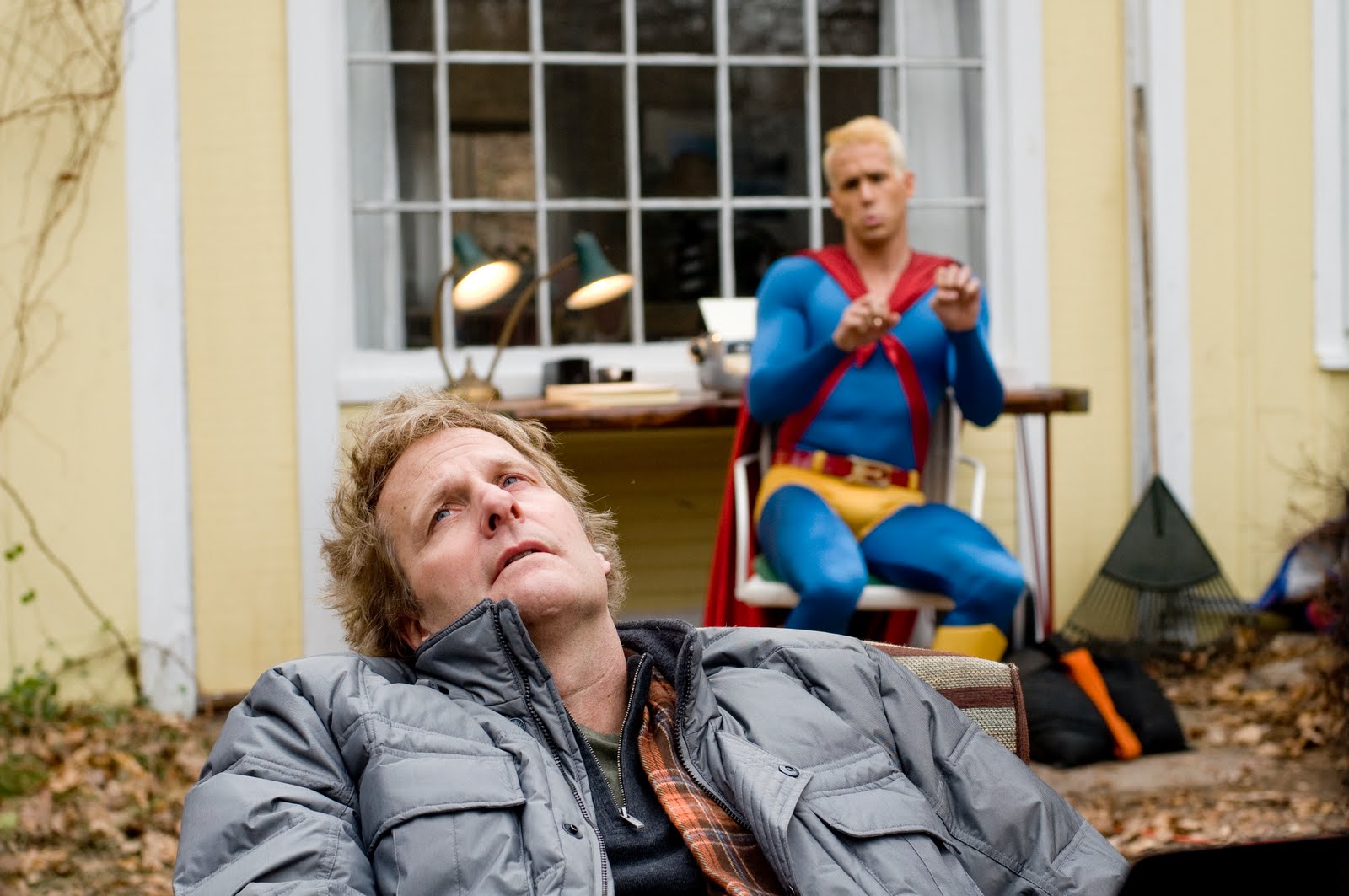
Clunky, overlong dramedy that begins, promisingly enough, about an author having a crisis of identity while on a retreat in Montauk, before deevolving into yet another indie about an older man and a younger woman helping each other get past their personal quirks. One key distinguishing factor in this one is that the man in the relationship, Richard, actually laments on how his problems are not "real" problems; however, he cannot gain enough objectivity to actually get over his white, bourgois inner turmoil, which is fine compared to the heavy-handed, sludge-paced dilemmas of his youthful, female counterpart. It is funny when Richard replaces his garish couch with a couch made out of copies of his unsuccessful novel, but it is not as funny when Emma Stone's Abby continually throws matches into a steel drum in an attempt to light garbage on fire for...no reason. Richard's most interesting personal quirk, one that never truly reaches its comic and dramatic potential, is his imaginary friend, the peroxide-haired Captain Excellent, who, with his stalwart nature and wisecracking tenacity, provides a consistent source of strength for the edgy, neurotic author. After a strong, humorous, and surprisingly touching first half, the film becomes more and more plodding, lifeless, and redundant, reducing every character to their most sappy, melodramatic cores and, for the most part, leaving the abundant comic curiosities of the film behind (although a late scene between Captain Excellent and another character manages to transcend the rest of the climax). The film would have had definite crossover potential had it managed to avoid these common, pretentious indie movie pitfalls.

Part of its potential crossover appeal would've been due to its excellent, prolific cast, which, essentially, bolsters the movie, and keeps it from being a total wash. The best of the actors is Jeff Daniels, who, as Richard, turns in one of the finest performances of his career. Matching the comic affability of Harry Dunne, while bringing his mental shagginess (but not his shaggy beard) over from The Squid and the Whale, he achieves an ideal balance between affability and complexity that sustains the films watchability, even at its most turgid and corny. Had the film remained more about him than the cliched, tired, and overused "teen relationship" plotline that transpires, this would have been a more memorable, noteworthy film. But the more Emma Stone's character reveals about her neuroses, troubled relationships, and self-doubt, the less true and concise the film feels. Which is not to detract from her performance, which, surprisingly, creates a human being out of what would, otherwise, be a series of character quirks and contrivances. The rest of the cast is up to snuff, as well: Kieran Culkin is likably angsty as Abby's best friend, Hunter Parrish is funny and showy as Abby's P.O.S. boyfriend, Lisa Kudrow is restrained and identifiable as Richard's barely-there surgeon wife, and Ryan Reynolds is ideal, albeit too seldomly shown, as Captain Excellent. It is really, truly too bad that the film ends up falling under the weight of its own pretension, and does not prove worthy of the performances and actors that have contributed to it.

Skip it, save for fans of Jeff Daniels, who really does turn in magnetic, strong work here. But, unfortunately, he does so for yet another quirky, low-key mid-life-crisis indie melodrama.

Wednesday, April 13, 2011

Local Hero (1983)

Heartwarming, surprisingly schmaltz-lite comedy about a representative for an American conglomerate who ventures to a small Scottish community in an attempt to buy the oil rights to the region. Peter Riegert plays the titular character, a through-and-through yuppie who flies into the small town fully aware of his fish-out-of-water status; the great joy of the movie is that, rather than realize how different he is from the townsfolk, he almost subconsciously finds comfort in their eccentricities, their amicability, and, in a delightful touch, their fully visible, smog-free sky. Burt Lancaster is on board as the corporate exec who sends Riegert on his quest, but rather than play another variation of his J.J. Hunsecker character from Sweet Sell of Success, he portrays him as a rather daffy, open-minded old codger; one infers that after a life of making harsh deals, compromises, and downsizing, he has just as much of his humanity left to discover as Riegert. The townspeople are neither morally flawless country bumpkins, nor Twin Peaks-esque Log Ladies and Men from Another Place, but rather normal folk whose patient, relaxed lifestyles stem directly from their environment. Another delightful, transcendental quality of the film is the score by Dire Straits frontman Mark Knopfler; defying both cliche and his own signature style, he provides various themes that are both appropriately moody and remarkably un-80's, despite the era.

Highly Recommended for fans of heartwarming, yet unconventional human comedies, such as Withnail & I and the original, 1981 Arthur. I am not easily won over by this type of film, where the character arcs are essentially telegraphed from the first reel, but this one rolled out with such unabashed optimism, human nuance, and defiance of cliche and expectation that I could not help adore the film by the near-brilliant finale.

Tuesday, April 12, 2011

The Apartment (1960)

Teriffic, swingin' 60's office comedy about a beleaguered clerk who gains standing in his company by allowing philandering executives access to apartment for their extra-marital trysts. Jack Lemmon secured his superstar status with his role as C.C. Baxter, the neurotic, high-strung cog in the machine who repeatedly sacrifices his dignity, his integrity, and much of his sanity in the attempt to advance his career; no stranger to spending the night on a park bench due to his "occupied" apartment, the film shows us how far he is willing to go before he decides to risk his job and reclaim his manhood. Just as he tenuously makes progress with his longtime crush, the cute elevator girl, played by Shirley Maclaine, his boss, Fred MacMurray, grants him a promotion with the stipulation that he must have on-demand access to Baxter's apartment to shack up with, you guessed it, the cute elevator girl played by Shirley Maclaine. The love triangle rambles along as MacMurray eventually assigns Lemmon the task of keeping an eye on Maclaine, which, inevitably, leads to lovey dovey scenes of their blossoming romance, with the increasingly stressed Lemmon being forced to definitively choose between the gold or the girl.

One of the most noteworthy aspects of this film, which no one had ever seen fit to mention in their appraisals of the film, is its firmly 60's era depiction of the workplace. The women are all secretaries, and, it is revealed, have all had affairs with their married bosses (until they got too old). The men are all joyous, fedora-sporting cads who amicably compete and banter without ever maliciously undermining each other for personal gain. There are plenty of cocktails drunk, floozies picked up, and codependent, selfless women; Maclaine's character is hopelessly in love with MacMurray, and provides a detached running commentary on the futility, and cliched nature, of her position as "the other woman." Fuck Mad Men; this is the real deal, without irony, in all of its politically incorrect, blissfully unaware glory. Lemmon's stalwart, yet career-minded schlub stands out among his peers for his minimal, but still-present respect for the opposite sex. His faded sense of morality makes him constantly edgy and nervous, and makes him both an identifiable, yet thoroughly watchable protagonist. MacMurray is surprisingly sympathetic as the big boss man, Maclaine is adorable and sympathetic as the perpetually dumped elevator girl, and Ray Walston kills it in a fast-talking smaller part as a coworker of Lemmon's. Billy Wilder made some very ambitious thematic choices for this era (including a scene, my favorite, of Lemmon picking up, and discarding of, an aging barfly floozy), and the end result is a film that has dated in all the right ways, and remains both a delightful narrative and a snapshot of a time, era, and mentality that does not exist (aside from bad xerox copies on AMC).

Highly Recommended for fans of Lemmon or Maclaine, or of classic business comedies such as Sweet Smell of Success or The Front Page (also with Lemmon). I have not seen Wilder and Lemmon's previous collaboration (the obscure, largely forgotten comedy Some Like it Hot), so I cannot say how it holds up, but that film would have to be simultaneously funny, involving, and surprisingly touching to land in this one's ballpark.

Wednesday, April 6, 2011

Rango (2011)

Inventive, ambitious, but somewhat void of emotion, this animated homage to spaghetti westerns revolves around the titular chameleon as he poses as a small-town sheriff (A+ for originality there) in an attempt to discover the true nature of his self (that part's better). The first act is the best, as Rango, voiced as a lively, scheming huckster by Johnny Depp, attempts to make his way through the desert after being unwittingly abandoned by his owners. With no presence of identity, instinct, or empathy, his futile efforts to contextualize his plight are very humorous and, dare I say, human, as plot takes a decided backseat to character development in these early scenes. However, once Rango arrives in the besieged town (*sigh*, there's always a besieged town), the narrative settles into the traditional western structure: 1. stranger arrives in town, 2. Series of circumstances force town into reverence of stranger, 3. stranger begrudgingly takes responsibility for the town, etc. blah blah they find out he's a fake and he has to stop being one anymore for the climax to go down in a satisfying, explosive way. Save for one third-act introspection sequence (which feels like the rest of the film from act one after a lengthy narrative detour), there are virtually no surprises in the latter half of the film, and everything that isn't deeply rooted in cliche is telegraphed miles in advance.

However, I must say, the character work in the film is strong enough to warrant checking out the film. For one, aside from the three leads (Depp, Isla Fisher, and Abigail Breslin), the casting is refreshingly anonymous (though not quite up to Despicable Me's daunting standards), with names like Harry Dean Stanton, Ray Winstone, and Bill Nighy turning in invisible and strong supporting work. They contribute to what ends up being the winning point of the film, its atmosphere. The sun-ravaged, desolate nature of the desert allows for a more cynical, worldly edge to the proceedings; sure all the different species of animals get along, but they are only doing so to survive in an otherwise uninhabitable region. The villains are mean, the heroes are open and endearing, and the supporting characters all but steal the film. But, in the end, the shallowness and obviousness on display are abundant enough to render any possible emotion or depth in the film moot and ineffective, and the film's thematic content, although sporadically phenomenal and magical, is basically left out to dry in lieu of explosions and flying bats with gatling guns (cool, but child's play compared to dogfighting dragons of all shapes and sizes *hint, hint*). That said, the opening 20 or 30 minutes are fun, interesting, and, surprisingly, provocative, and along with the breezy and easy pacing and tone of the film, as well as its deep respect for spaghetti western aesthetics, it is impossible for me not to recommend this film to anyone who thinks it would be worth their time.

Slightly Recommended to fans of slightly off-kilter animation (this is a Nickelodeon Films production, and is accordingly out there, without blowing kids' minds) or spaghetti westerns. While the film gets a little too clever, and not involving enough, for its own good, it is a fun romp that, thankfully, does not require 3-D to create its own immersive world.

Sunday, March 6, 2011

What a Way To Go! (1964)

Packed, front-to-back, with old-school Hollywood glam, but ultimately hollow, this star-studded affair concerns a young heiress as she recalls, to a psychiatrist, the circumstances that led to the various deaths of her previous husbands. Shirley MacLaine plays the bereaved, but ditzy young woman, who we see progress from a young, naive farm girl to an endowed, but still innocent millionaire. In an early role, MacLaine is hilarious and adorable; while not conventionally attractive, she possesses a certain quirky earthiness that provides a sharp contrast with the traditionalism of her contemporaries (Elizabeth Taylor, Audrey Hepburn). However, due to the episodic nature of the film, the energy of the film is maintained only through the caliber of male co-stars they managed to dig up for MacLaine: her ill-fated husbands include Dick Van Dyke, Dean Martin, Paul Newman, Robert Mitchum, and Gene Kelly. They are all exemplary, highlighting various aspects and methods of attaining wealth, from Newman's anarchic, Pollack-esque artist to Robert Mitchum's big business executive. Newman and Martin fare the best with their zany, cartooney characters, while Kelly's sub-interesting throughline leaves him with little more than his quick feet to work with.

Aside from a co-star, each sequence gets a specific interlude where, in a musical montage, we see how MacLaine's character has encapsulated these relationships in her mind. For example, Dick Van Dyke's clumsy schlub gets a goofy, black and white silent-film bit, while Mitchum's penthouse provides the stage for a fashion show for Edith Head's phenomenally larger-than-life costumes. Director J. Lee Thompson has the most fun in these scenes, which are far more ironic and meta than many of the sillier, but equally gaudy '60s Hollywood vanity pics. However, in the end, the episodic nature, and the unfortunate positioning of Kelly's sequence as the sendoff, keep the energy of the film from going full speed, and keeps it as, merely, a gorgeous, but hollow postcard to a lost era in big-budget, production design-heavy Hollywood filmmaking.

Slightly Recommended for fans of the cast or really absurdly lavish and busy Technicolor Hollywood musicals of the '50s and '60s. There are a couple of truly memorable set pieces and musical numbers here; too bad they are not wrapped around with something more thematically ambitious.

Monday, February 21, 2011

Paul (2011)


Adorable, culturally savvy road comedy about 2 English geeks who, en route to Area 51, encounter, and befriend, a foul-mouthed alien as he attempts to flag down a spaceship home. Opening with our two heroes at Comic-Con, and riddled with referential dialogue, this is nearly a nerd-exclusive affair, with our protagonists being people who have always dreamt of the very adventures they end up going on. The two main characters are played by Simon Pegg and Nick Frost, and, as in Shaun of the Dead, and Hot Fuzz, their relationship has a very bromantic, borderline-homoerotic feel, which may prove uncomfortable for many hetero males on this side of the pond. Personally, I found their interplay in this one hyper familiar and immediately endearing; these guys, with Pegg's as the stumbly romantic lead and Frost as the sweet, but obtrusive lovable oaf could be England's Hope and Crosby, going on fantastical adventures with their own signature comic tone. However, once Paul enters the picture and takes center stage, the film becomes less about them and more about him, and, inevitably, less specific and more palatable for mainstream audiences.

I was worried that Paul's entire character would be in his description: "swearing, culturally literate wiseass." Luckily, as written by Pegg and Frost and voiced by Seth Rogen, Paul ends up having a very clear, likable identity, void of cliche and full of genuine comic energy. The gags they blatantly vomit at you in the trailer (I'm quite bitter at the amount of gags that are ruined in the newest red-band trailer that seem STUPID in the ad but are HILARIOUS in the final film), such as Paul's powers of resuscitation, are, in the film, well-earned and contain substantial payoffs. The whole film has a strong sense of cohesion to it, from the running gags to the development of the human trio's (they pick up a third human, played by Kristen Wiig) relationship with Paul. The action/chase scenes are played straight, yet contain humor and hardly break the flow of hte film. And the villains are very cleverly thought out and presented.

As the primary G-man on Paul's trail, Jason Bateman quietly steals the movie away from its headliners. He dials down his trademark boyishness and lays on a cold, "Men In Black" vibe that perfectly complements his deadpan delivery. Part of the non-nerd side of the equation, Bateman's character nonetheless squeezes in several subtle cultural references that had me, in equal measures, howling in laughter and weeping. The supporting cast is peppered with comic talent: aside from Wiig, Bill Hader and Joe Lo Truglio play Bateman's naiive local assistance, John Caroll Lynch is Wiig's psychotically possessive Christian father, David Koechner shows up as a decidedly un-Anglo-friendly hick, and Jeffrey Tambor, Jane Lynch, and Sigourney Weaver (!) turn in fun cameos.
However, Seth Rogen's work as Paul is really what bolsters down the movie and keeps it from being a neat, geek-friendly concept piece. While we all know he can deliver half-stoned witticisms like it's nobody's business (and he does), Rogen takes it a step further and really plumbs the depths of his character. As interpreted by Rogen, Paul feels less like a laid-back, cool dude, but rather a kind of sullen, lonely, somewhat reserved outcast; he is thoroughly culturally literate, down to understanding the humor of asking the guys to buy him Reese's Pieces (more on that later), but it seems like he has adopted these cultural elements out of necessity and neglect, rather than any sort of spiritual affiliation. He wants to fit in and connect with people, despite how he looks, and the film achieves a distinct poignancy when exploring the various relationships Paul makes on Earth. Rogen's inherent everyman qualities make Paul especially endearing and identifiable, and, I feel, easily acceptable and likable by American audiences (alas, we'll see.). While it is clear that E.T. was the jumping off point for this project, with its candy-coated male bonding and the lobotomy-happy G-men hot in pursuit, it does not settle for that films underhanded sentimentality, and never devolves into nostalgic or schmaltzy dreck; in the end, it earns its more heartfelt moments because of its unwillingness to pander or to fully remove comedy from the equation, which many similar films end up doing in their third acts. As is, it is a hilarious, moving, and thoroughly memorable sci-fi/comedy, and another phenomenal, instant-classic (at least, for me) entry into the Pegg/Frost canon, which, I pray, does not end with this wonderful film.

Highly Recommended for fans of Pegg/Frost's earlier films, Shaun of the Dead and Hot Fuzz, or of the comic cast in general. Director Greg Mattola has outdone himself here, topping his previous films Adventureland, Superbad, and, even, The Daytrippers in almost every way possible.

Saturday, February 19, 2011

Your Highness (2011)

Laugh-out-loud, ambitious fantasy-comedy about a pair of medieval-era princes, one handsome and stalwart, the other a Kenny Powers-esque slob and philistine, who team up to save the handsome one's bride from an evil wizard. Along the way, they get involved with many genre-appropriate side-quests and obstacles, eventually forming a bond with a female warrior who, inevitably, is the philistine's love interest. The true innovation of this movie is a reappropriation of the tone of 2001's A Knight's Tale, with it's amalgam of era-appropriate and anachronistic dialogue and circumstances, just done to the umpteenth degree; while some scenes are riddled with "thines" and "thous," in one of my favorite moments, the handsome prince reacts to news of the female warrior's joining of their party with a genuine, "Nice!" However, to counteract the fantasy stuff, the first hour (prior to the addition of Natalie Portman's badass chica) has a very strong buddy comedy element, with the two princes having a strained, yet bro-y relationship that recalls David Gordon Green's last film, Pineapple Express; separating the two for third-act tension is the film's most crucial flaw, along with the lack of a payoff a la the brilliant "I'm gonna save you, man" scene in the latter film. The fantasy stuff is very cool, and played surprisingly straight, with some pretty inventive and creative scenarios and creatures, but the ending promises a more spectacular display of magic and wizardry than it ultimately delivers on. Ultimately, the film achieves a tone not unlike Land of the Lost, where, while there are genuinely cool things going on, the true essence of the film is defined through its comedy and its tongue-in-cheek tone.

While I figured, prior to seeing the film, that Danny McBride would kill it as what is essentially a dark age-era Kenny Powers, cussing, womanizing, and abusing drugs with an intense, thoroughly intent vigor, it is James Franco, as the foppy heir to their fathers throne, who ends up standing out. Investing his character with a different sort of sexual and behavioral naivete than his character from Pineapple Express, he smiles, poses, and sings (terribly) through the film without once taking his character too far into the realm of the obnoxious superstar role; he has true love for his brother, and actually respects him for not succumbing to the superficial, castrating pressures of the royal court and their father. However, about an hour or so in, he joins his love interest (a surprisingly funny, but disappointingly sparse Zooey Deschanel) in captivity, and Natalie Portman permanently joins McBride to defeat the evil wizard and save the two lovers. Here, without the constant verbal interplay of Franco and McBride, the film begins taking itself too seriously, and several unnecessary plot elements begin to develop, before faltering and being forgotten about. While the action in the final showdown IS big, and only slightly anticlimactic, it is not dynamic or interesting enough to cover for the decided lack of laughs in that section of the film. That being said, the rest of the film balances its tone nicely, with Charles Dance, Damian Lewis, and Toby Jones (well, maybe not Toby Jones) adding a touch of gravity and dimension to the proceedings, but it only barely survives the cliched, lazy plotting the film eventually succumbs to. And Natalie Portman, skivvies or no, is having a tremendously overexposed year, with Black Swan, No Strings Attached, The Other Woman, Thor, and this all opening within THE FIRST 6 MONTHS of 2011. Her familiar, and boringly Episode 1-ish appearance in the film deflates much of the momentum from the films sails, and the successive beats that work function despite, and not at all in due to, her presence.

Recommended to fans of goofily epic and large sci-fi/fantasy films, a la Land of the Lost, or Judd Apatow buddy comedies, like the aforementioned Pineapple Express. There are a number of potsmoking references and scenes, but this is not the stoner comedy its title would lead you to believe; way more Krull than Cheech and Chong.

P.S. Justin Thereoux may be slightly too cutesy and self-aware as the evil wizard, but he gets some INCREDIBLE moments and lines, such as the already iconic response to the King's, "And how do you expect to do that?": "Magic...motherfucker!!"

Saturday, January 22, 2011

The Green Hornet (2011)

Lively, if uninspired buddy action flick about a heir to a publishing magnate who decides, alongside a faithful houseservant, to take up crimefighting to redeem his aloof, partygoing ways. That's about as much specificity as the plot allows; Cameron Diaz as the love interest is a tired rehash of Gwenyth Paltrow's Iron Man character, the buddy banter is, for the most part, disposable, and the villain is the stock superevil "head of crime in all the city" character. That being said, that villain, as played by OSCAR WINNER Christoph Waltz, is the funniest, most interesting part of the movie, as he repeatedly , and in vain, tries to come off as the scary, stock character he was clearly written to be ("Look at my gun! It has TWO barrels!!") Michel Gondry's visual work is what keeps the film afloat, in the end. There is strong production design throughout, the action scenes are energetic and clearly presented (Kato's first fight scene is pretty outstanding), and the pacing is pretty quick for a movie with literally no plot. The gas gun, annoyingly featured in every trailer for the film, is not overused, and the similarly overexposed Hornet car actually performs some surprising, original tricks by the films end. And it's nice to see two underutilized actors who saw their hayday when this time of film was in vogue: Edward Furlong and Edward James Olmos. However, the whole thing has a very been there, done that vibe that definitely contributes to this film being shoehorned into a mid-January (?!!) release; this was the only way this flick was going to break 30 mil opening weekend.

Tuesday, January 11, 2011

Winnebago Man (2009)

Humorous, semi-pointless doc about famed Winnebago salesman Jack Rebney, whose antics were captured in a cult youtube video that inspires a young documentarian to track him down, some 20 years later. The film opens with clips of the infamous video, which is actually a collection of outtakes from a Winnebago commercial from the late '80s. It shows Rebney continually breaking down in profanity-riddled tirades and acting cuckoo in front of the camera; while we laugh at him, his insecurities and apparently uncontrollable emotional outbursts make him a somewhat identifiable and human figure. This is what Ben Steinbauer wanted to follow up on with this documentary, and I'm not 100% certain he succeeds. There is a slight progression, as Rebney initially finds it difficult to reconcile his image with his personality, and then concluding with a festival for found videos where he is a guest of honor, but we never really learn anything about Mr. Rebney. He displayed his inherently human characteristics in the video, and, while it is fun to get a glimpse into his home life (he does not leave his house in the woods, and only hangs out with one ultra-personal friend), at feature-length, his demeanor begins to prove redundant and somewhat forcced; we get the idea that at his old age, he would not swear and make such a fit had Mr. Steinbauer not goaded him into it. That being said, he is a funny, interesting figure, and does not make one regret having watched this doc.

Slightly Recommended for fans of his youtube video or character-based documentaries. I'd say youtube Jack Rebney, and see if the video intrigues you to seek out this doc.

Nothing Lasts Forever (1984)

A surreal, thoroughly original comedy about a young man who goes to New York City to make it as an artist, only to discover that the Port Authority has hijacked the city into a repressive, function-oriented dystopia. Zach Galligan from Gremlins plays the lead, an amiable, fresh-faced small-towner who is determined unfit to be an artist, and is forced to work the tollbooth at the Holland Tunnel. He attempts to break through the art world by proxy, only to find it is a dense, insular subculture where absurdism is mistaken for poignancy, and superficiality dominates. Eventually, he discovers a society of divinely-wise homeless people, and is tasked with saving the moon. Oh, and the entire film is presented, in style and tone, like a Frank Capra film from the '40s.

The film was written and directed by Tom Schiller, who contributed many short films to SNL over the years, and this film is somewhat in the style of his more bizarre, surreal work for that program. Although clearly well-versed in classic Hollywood, Schiller is not content with merely aping the era, but rather using it to portray his bizarre story in a way that carefully treads the line between camp and sincerity. If the film was an empty excercise in style, it would not warrant a feature film, but Schiller and Galligan provide enough genuine, irony-free substance that the narrative is simultaneously completely silly and thoroughly engaging. There is a climactic musical number by Bad Santa's Lauren Tom that achieves an obscure, fragile poignancy that very few films of the era evoked, especially the mainstream comedies. The presence of Dan Aykroyd and another classic SNL alum (he's credited, but I refuse to specify who due to the perfection of his opening moments) ensures some familiar, straight-laced comedy, but mostly, the laughs are in the sheer absurdism of Schiller's storytelling methods and 1940's sensibilities. It is a fantastical, dreamlike film, and warrants a greater appreciation than it currently receives from academia (though that is most likely due to its lack of DVD availability).

Highly Recommended for fans of more original, anarchic comedy, or of old 1970's SNL. The film can be seen here, or can be downloaded off of a VHS copy on Bittorrent. There is genuinely nothing quite like this movie; a true lost classic.

Wednesday, December 15, 2010

Red (2010)

Paper-thin, fleetingly entertaining action-comedy about a group of retired assassins who reteam to take out a public official gunning for them. The star-power driven black comedy that the marketing materials implied is not what the actual movie ends up being; John Malkovich's paranoid ravings, a central focus of the trailers, is mostly loaded onto the tail 45 minutes of the film (during which, I must mention, second-billed Morgan Freeman is nowhere to be found). The first act, nearly dreadful in its staleness, involves Bruce Willis' retired 50 year-old assassin excitedly reentering the intrigue business, along with his pension manager (oh, please), played by Mary-Louise Parker. The dialogue is tired, the action is lame and unremarkable, and the interplay with Willis and Parker is forced, saved only by Parker's natural likability. The movie reminds me of the similarly hit-man themed Mad Dog Time, in the way that it's paced as a series of guest appearances of the spies and assassins that Willis goes to for information or assistance; among them, aside from Malkovich and Freeman, are Helen Mirren, Brian Cox, Ernest Borgnine, Richard Dreyfus, and, as a rival hit-man, Karl Urban. It is disappointing to say that only Malkovich and Cox get anything juicy to work with, especially considering how effective the idea of Dame Mirren blasting away baddies with machine guns sounds on paper. Urban is strong and imposing, but no more so than when he appeared as a similarly resourceful hitter in The Bourne Supremacy. The whole thing is an excercise in futility; while it, no doubt, helped secure B.O. (and a freaking Best Comedy or Musical Golden Globe nom!) to have these esteemed actors going on publicity tours promoting their smallish parts in the film, it set up a star-power fueled film that has way more laughs and excitement than what's on display here.

Skip it, save for completionist fans of the cast, or genuine Brian Cox fans; the romance between his Russian ambassador and Helen Mirren's ex-MI6 assassin is easily the most charming, understatedly effective aspect of the film. If you told me, prior to seeing the film, that he would steal the film from such a high-wattage cast, it would probably seem as crazy as Mickey Rourke being the truly biggest badass in The Expendables. Who can ever tell with these movies?