Showing posts with label Western. Show all posts

Wednesday, May 11, 2011

Drive Angry (2011)

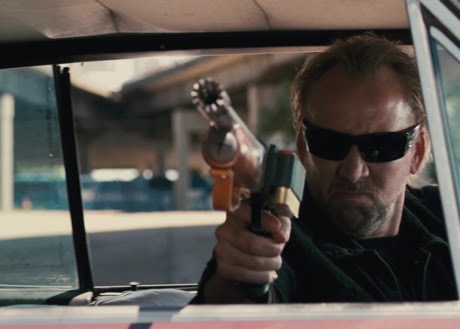
A surprisingly fun, self-aware enterprise, this relentlessly aggressive throwback to '70s car flicks such as Vanishing Point revolves around a near-psychopath as he attempts to rescue his kidnapped granddaughter from murderous satanists. The film never gets too much more complicated than that; aside from a couple of other characters, such as a beleaguered waitress and a mysterious "Accountant" in pursuit, the narrative is almost solely tied into the protagonist's quest for his missing granddaughter. The race-against-the-clock aspect, along with the cult aspect, reeks of '70s exploitation, and the film is definitely in that mold, eschewing logic for impact at any given moment. However, unlike similar exercises in action meta-awareness (like Shoot 'Em Up), this one actually knows where to draw its goofy/serious battle lines, with the slower moments having just as much dirty, grimey, pulpy energy as when it's at its most kinetic. That is not to say the action is not up to snuff; bullets fly at the screen, sex is rampant, and, for a film of this budget, the car stunts are surprisingly large-scale and well-rendered. And the cast, not an Ocean's 11 ensemble by any means, is wonderfully game.

I had read, prior to seeing the film, that Nic Cage plays against his strengths in this, going for a "Man With No Name" vibe, as opposed to his own patented explosivity; I call bullshit on that. While he is not screaming "It's murder! MURDER! And you're all guilty! GUILTY!!!", he is definitely aware of the silliness of the production, and takes his character to various extremes, but never condescends to the material; if I had to guess, I'd say this and Kick-Ass were more the kind of work he'd like to be doing than Sorcerer's Apprentice and Season of the Witch. As his waitress cohort and co-lead, Amber Heard is vicious, vivacious, and all sorts of awesome, giving this role a decent amount of humanity, and never once seeming like a desperate wannabe starlet running away from pyrotechnics. She has consistently turned in strong work in all that I've seen her in, but if she plays her cards right, Heard could easily make a career as a tough action heroine, sexier than Michelle Rodriguez and more fiery than Angelina Jolie. Billy Burke (who I recognized from Jane Austen's Mafia) is an effectively eerie villain, and David Morse shows up in an extended cameo as a friend of Cage, but the real highlight of the acting department is William Fichtner. Instantly recognizable, but elusively eclectic, Fichtner all but steals the film as the Accountant, seemingly toying with everybody in the film; neither a hero, nor a true villain, his character exists only to toy with civilians and to increase the stakes for Cage, both of which he does with a great sense of relish that I hope to see more of from the talented actor. He really has established himself as a modern day Warren Oates, or Elisha Cook, Jr., killing it in talented directors' work without ever worrying about being typecast or overexposed (remember his opening scene in Dark Knight?).

Highly Recommended for anyone who thinks that they'd like a movie called Drive Angry 3D starring Nicolas Cage and Amber Heard. Or for anyone who has ever said to themselves, "You know? They really don't make 'em like Vanishing Point anymore." I have. And they did.

Monday, May 9, 2011

El Topo (1970)

Strikingly original, yet slightly overlong, this surreal western tells the story of a gunfighter as he trains his son, rescues a damsel, hunts down rival gunmen, and, finally, seeks redemption. The imagery of this film is its most striking element. Utilizing its fullscreen scope to its full potential, the exposures of the sky, the desert, the caves, and the mountains contained within the film are all absolutely gorgeous and picturesque. The imagery is heavily slanted towards religious symbolism, which, thankfully, is not specific enough to turn off atheists and agnostics (like myself). The action is effective, but minimal and quickly-cut; this is not a Sergio Corbucci actioner, by any means, but a more broody, evocative piece, where the violence, although prevalent, is the exception to the rule. The first part of the film is a more traditionalist western, with the gunfighter being taunted by his woman into challenging the four master gunfighters in the area. Each of them have their own method of survival, directly tying into their philosophy of life, which the gunfighter is then forced to emulate or subvert in order to achieve victory. Had the film been solely about this narrative, it could have been a more open-minded, spiritual cousin to the other foreign-made westerns coming out at that time (see Leone and Corbucci). However, writer/director/star Alexander Jodorowsky tacks on a whole other act, jumping forward a decade-plus, showing the gunfighter on his path to redemption.

Although there is plenty of inspiring, poignant footage within, it is this section of the film that is the most problematic. For one, the other characters of the film disappear, and the one(s) that remain are magnificently warped, creating a brand new plotline almost completely separate from what came before. This could be very brave, and, potentially, outstandingly effective, if not for the second crucial problem, which is that the new plotline is, surprisingly, rather cliched. The gunfighter is nursed to health by a band of malformed outcasts, and he becomes a monk, devoting himself to reintroducing his new friends back into mainstream society, possibly by force. While there are interesting aspects to this, such as his dwarf love interest and the uncompromisingly brutal ending, it is fairly preachy and, dare I say, soft in comparison to what came before it. It remains a hauntingly executed, astoundingly inventive western, one that shares much more stylistic commonalities with Orson Welles and Godard than Sergio Leone or John Ford. However, I cannot forget the feeling of waiting for the film to end, and seeing the multiple opportunities to do so effectively without dragging the more sentimentalist, middling elements of the film out to their breaking point.

Recommended for fans of highly original, New-Wave influenced work of the late '60s, early '70s, or of less conventional, more outside-of-the-box westerns, such as Dead Man or High Plains Drifter. I am definitely fascinated enough with Jodorowsky's style to seek out his grand opus, Holy Mountain, which, without the trappings of the traditionalist western, I can imagine will be an even more revelatory, striking experience.

Wednesday, April 6, 2011

Rango (2011)

Inventive, ambitious, but somewhat void of emotion, this animated homage to spaghetti westerns revolves around the titular chameleon as he poses as a small-town sheriff (A+ for originality there) in an attempt to discover the true nature of his self (that part's better). The first act is the best, as Rango, voiced as a lively, scheming huckster by Johnny Depp, attempts to make his way through the desert after being unwittingly abandoned by his owners. With no presence of identity, instinct, or empathy, his futile efforts to contextualize his plight are very humorous and, dare I say, human, as plot takes a decided backseat to character development in these early scenes. However, once Rango arrives in the besieged town (*sigh*, there's always a besieged town), the narrative settles into the traditional western structure: 1. stranger arrives in town, 2. Series of circumstances force town into reverence of stranger, 3. stranger begrudgingly takes responsibility for the town, etc. blah blah they find out he's a fake and he has to stop being one anymore for the climax to go down in a satisfying, explosive way. Save for one third-act introspection sequence (which feels like the rest of the film from act one after a lengthy narrative detour), there are virtually no surprises in the latter half of the film, and everything that isn't deeply rooted in cliche is telegraphed miles in advance.

However, I must say, the character work in the film is strong enough to warrant checking out the film. For one, aside from the three leads (Depp, Isla Fisher, and Abigail Breslin), the casting is refreshingly anonymous (though not quite up to Despicable Me's daunting standards), with names like Harry Dean Stanton, Ray Winstone, and Bill Nighy turning in invisible and strong supporting work. They contribute to what ends up being the winning point of the film, its atmosphere. The sun-ravaged, desolate nature of the desert allows for a more cynical, worldly edge to the proceedings; sure all the different species of animals get along, but they are only doing so to survive in an otherwise uninhabitable region. The villains are mean, the heroes are open and endearing, and the supporting characters all but steal the film. But, in the end, the shallowness and obviousness on display are abundant enough to render any possible emotion or depth in the film moot and ineffective, and the film's thematic content, although sporadically phenomenal and magical, is basically left out to dry in lieu of explosions and flying bats with gatling guns (cool, but child's play compared to dogfighting dragons of all shapes and sizes *hint, hint*). That said, the opening 20 or 30 minutes are fun, interesting, and, surprisingly, provocative, and along with the breezy and easy pacing and tone of the film, as well as its deep respect for spaghetti western aesthetics, it is impossible for me not to recommend this film to anyone who thinks it would be worth their time.

Slightly Recommended to fans of slightly off-kilter animation (this is a Nickelodeon Films production, and is accordingly out there, without blowing kids' minds) or spaghetti westerns. While the film gets a little too clever, and not involving enough, for its own good, it is a fun romp that, thankfully, does not require 3-D to create its own immersive world.

Wednesday, January 19, 2011

The Three Burials of Melquiades Estrada (2005)

Both graceful and immediate, this western concerns the repercussions of the murder of a Mexican ranchhand in Texas. Tommy Lee Jones, who also directed, stars as the rancher to whom Melquiades was both an employee and a dear, personal friend. He goes on a quest to discover the identity of the murderer in order to extract what he sees as the appropriate punishment. There is little mystery; I won't reveal it here, but the killer is revealed by the end of the first act, and the rest of the film involves him and Jones reconciling their notions of what happened and how important Estrada's humanity remains in his death. The film takes place in dirty, secluded Texas/Mexico, and it's a slow film, but punctuated by moments of heightened violence and emotion; this is more Sayles than Peckinpah. The acting is impeccable across the board; aside from a characteristically nuanced and mature performance from Jones, Barry Pepper, January Jones, Melissa Leo, and Dwight Yoakam turn in subdued, realistic portrayals that make the progression of the piece far more interesting than any outcome. Jones paints a flat, half-dead landscape out of Texas, and contrasts that with a lively, earthy presence in the Mexico scenes; it is not hard to infer Jones' opinion of that nation and its people, particularly in relation to their treatment by the U.S. This is not a film that can be universally appreciated by modern audiences, but rather one that takes its time, refuses to shower one in spectacle, and delivers a strong, human story that says plenty both about human nature and the current state of racial politics down south.

Highly Recommended for fans of slower-paced westerns, Tommy Lee Jones, or Barry Pepper. This and True Grit are great evidence for Barry Pepper's continually impressive talent, and that he deserves more prominent big-screen work.

Thursday, December 16, 2010

Faster (2010)

Fun, but uneven actioner starring The Rock as a recent parolee who goes on a killing spree to avenge his dead brother. That logline is about as much plot as was divulged in the marketing for the film, and that's about all you need to know; there are other plot elements, but they're window dressing. There is an assassin who is hired to take The Rock out, who, upon realizing how determined he is in his revenge, almost decides to settle down with his fiancee, Maggie Grace. There is a cop, played, with an almost unbelievable professionalism, by Billy Bob Thorton, who is also in The Rock's pursuit, while simultaneously trying to keep his heroin habit in check for his last week before retirement (he actually states how many days he has till retirement with a straight face, talk about professionalism). And there are the random gunmen who took out his brother, who now occupy such (relatively) harmless positions as a preacher, an office worker, and a club bouncer. The violence in the movie is relentless and, at least for the first half, nearly amoral; The Rock has never been this merciless or gritty on film, and it looks good on him. The story inevitably catches up with the hyper-quick pace the title promises, and the film has its share of slow patches, but the story elements are sufficient and comically sparse, and Billy Bob's subplot provides enough pathos to keep things from getting too pointless. That being said, this is not the movie it could be, nor the movie the marketing (and the title) promise it to be; it's a near-western/revenge story more Death Wish than Death Wish 2-5, just, you know, not as good.

Slightly Recommended to action buffs and non-child fans of The Rock; I could call him Dwayne Johnson, like he wants, but, dammit, he's The Rock, and The Rock should be doing more movies with names like Faster and less with the word "Walt Disney presents..." preceding them.

Sunday, July 25, 2010

Extreme Prejuidice (1987)

Fun, exciting Walter Hill actioner set in Texas about the elongated rivalry between a Texas Ranger and his boyhood friend, now a cocaine kingpin in Mexico. Nick Nolte and Powers Boothe are the Ranger and the kingpin, respectively, and they have been fighting over Maria Conchita Alonso since before they acquired their legally-opposing occupations. Their story is the A-plot; there is also Michael Ironside and his ex-military crew, including William Forsythe and Clancy Brown, working against Boothe as well, albeit in a more covert manner. Eventually, inevitably, the two plots converge into an explosive finale in Mexico. The addition of the ex-military unit subplot adds a lot of dimension to the proceedings, although the good ol' boy rivalry between Nolte and Boothe is a delight. The parallel plots successfully create the idea that multiple things are actually concurrently going on, which elevates this above your typical forgotten 80's actioner. Aside from the action, which Walter Hill expectedly executes exceptionally well (especially the Wild Bunch-influenced finale), the badass supporting cast also makes this film stand-out. Aside from the three terrific, slow-burn leads, Nolte, Boothe, and Ironside, Forsythe, Brown, Alonso, and especially Rip Torn as Nolte's superior turn in memorable, appropriately archetypal action character work.

Recommended for fans of Texan (or southern) '80s action flicks, the leads, or Walter Hill; like many of his other films, this is, ostensibly, a classic western tale, but the addition of the ex-military unit subplot (and the cast) keeps this from feeling like any sort of retread, and makes it a compelling AND exciting dust-covered guy flick.

Wednesday, April 14, 2010

The Good The Bad The Weird (2010)

Fun, if unremarkable Korean western that sustains an unremarkable plot with a breezy pace and exciting scenarios. The story is basically a retread of The Good, The Bad, and The Ugly; a drifting badass and a thieving buffoon team up to find a lost treasure, with a traitorous mercenary hot on their tail. While the film apes Leone's story beats, it does not even try to appropriate his style; the long, deliberate takes of Leones are replaced by quick pans and cuts that keep the film moving along quickly enough to look past its faults, namely the soullessness of characters based on better, more nuanced performances. Aside from "The Weird," played by Chan-Wook Park mainstay Song Kang-ho, the central roles are played, for the most part, at face value, with little subtext or mystery present until the final scene, which actually does manage to impress. The set pieces of the film are very well executed, if a tad contained, and the action comes often enough that the hackery of the script rarely catches up with the film. However, even when compared with something like Sukiyaki Western Django, which took its ridiculous plot to even further visual and kinetic heights, it does not make for particularly relevant or compelling viewing for most film goers.

Slightly Recommended for fans of goofy westerns a la Sukiyaki Western Django. This is, as I should've guessed, a clear case of style over substance. If that's your bag, especially in relation to westerns, this is a fun way to spend 2 hours and 10 minutes. Otherwise, there are better movies of the sort worth seeking out.

Tuesday, February 23, 2010

Seargent's 3 (1962)

Meandering, mediocre Rat Pack western made tolerable only through the professionalism of director John Sturges and the sheer watchability of the Pack. The plot is nonexistent for most of the film, and just involves western cliches until the last half hour, where an imminent "Indian" invasion takes top priority. The production is obviously, more so than even Robin and the 7 Hoods, an excuse to get the crew on screen, and in that sense, it works; Frank is the stalwart leader, Dino is the amiable drunken badass, Peter Lawford is the stubborn educated type, and Joey Bishop is the comic doofus. Only Sammy Davis, Jr. gets shafted, with his shuckin' n' jivin' antics offending from his first minute on screen. The racism of the piece extends to its treatment of the Native Americans, which is stereotypical of American westerns of the time; it was two years before A Fistful of Dollars would make all these movies look like the racist pieces of shit that they were. However, aside from the racism, John Sturges does a surprisingly strong job with the material given, and creates a mythic backdrop for the Pack that extends beyond obvious sets and props. Some of the shots were among the most impressive of any of the Rat Pack films, and, at select moments, reached the epic scope of the infinitely superior Gunfight at the O.K. Corral. But alas, the movie does not create the levels of tension, humor, or drama to warrant a wholehearted recommendation, and without the effortless charm of the Chairman and his boys, the film would be a true bore.

Slightly Recommended to diehard Rat Pack and John Sturges fans. I wasn't expecting much, and I got what I expected; definitely inferior to Ocean's 11, if not also Robin and the 7 Hoods.