Showing posts with label Black Comedy. Show all posts

Monday, May 16, 2011

Hobo With A Shotgun (2011)

Simultaneously gritty, campy, and laughably grotesque, this true grindhouse product shows a crime-ridden city, riddled with corrupt cops, psychopathic mobsters, and a general sense of anarchy, as a beaten, morally uncompromised homeless man takes a stand for righteousness. The film is straight out of the Troma school of filmmaking, which, in this case, is a compliment; the over-the-top irony of it all, the hyper-reliance on sensationalism and violence, and the cartoony, straightforward protagonist (in this case, a hobo with a shotgun). However, the production values on display are of a noticably high quality than much of Troma's output, with the gore being fully realized and awesome, the sets and cinematography feeling well-realized and unrushed, and the presence of the veteran grizzled badass, Rutger freaking Hauer. For those of you who don't know who Rutger Hauer is, hopefully you've seen Blade Runner so you know how amazing he is as the "villain," Roy Batty, in that one. Otherwise, seek out The Hitcher (the original, GOD it annoys me that I have to specify that), the film version of Buffy the Vampire Slayer, or Nighthawks to see how moody, intense, and just plain scary this guy can be. Here, his dead-serious attitude not only makes his character a blast to watch, in contrast with the outlandish, ridiculous elements that surround him, but holds up the entire film, which could have been lost in a sea of irony and self-parody without him. The rest of the cast is good, but not up to Hauer's transcendent standard, save for Gregory Smith, who successfully subverts his former presence as a child-actor in films like Small Soldiers and Harriet the Spy with his deliciously psychotic guido character (I really wish more people could have the same 'Is that Gregory Smith?' moment I had while watching him torch schoolbusses full of children and the like). The gore moments here are extreme and in abundance, unlike the other grindhouse trailer adaptation, Machete (Hobo With A Shotgun started as a short film entry for a grindhouse contest, which actually played before the Machete trailer in the Canadian prints of Grindhouse), and makes up for what it lacks in budget and big-scale Hollywood set-pieces with strong makeup and clever ingenuity; in short, it is a near-ideal Troma movie, just made without the input of Lloyd Kaufman and his cronies. My largest gripe with the film is with the "hooker with a heart of gold" character that the Hobo befriends, which was poorly acted and conceived, and, more egregiously, deflated the pace of the film. However, even she gets her moment in the sun by the end, stabbing baddies with a wonderfully improvised weapon, but that doesn't escape the fact that she serves as a grounding and realistic element in a film that gets its sickest and purest pleasures from going gleefully off the rails.

Recommended for fans of more outlandish cult films, such as Six-String Samurai or Tromeo and Juliet, or of Rutger Hauer or Gregory Smith, both of whom are phenomenally and scene-gnashingly grotesque. This one's easy to get ahold of, and it's worth hunting down as it actually fulfills its promise of being a take-no-prisoners, blood-soaked revenge picture.

Wednesday, May 11, 2011

Tucker and Dale vs. Evil (2011)

Cute, low-key horror-comedy about duo of well-meaning, but buffoonish rednecks on vacation who are vilified, demonized, and, indirectly, tortured by a nearby group of teens. The central joke of the piece is a riff on Deliverance; because Tucker and Dale fit the image of inbred, angsty jungle folk, the teens are so scared for their lives that they, in turn, go about putting themselves in actual danger. There is not much more in terms of plot, save for a cute, tenuous romance with Tucker and one of the teens, so I will not ruin any of the gags, plot twists, or death scenes(!) that make this quite a fun watch for horror buffs. I will say that as the titular duo, Reaper's Tyler Labine and Alan mothafreaking Tudyk are absolutely sweet, well-rendered, and hilarious; if you did not buy the well-meaning sincerity of their rough-around-the-edges characters, the entire film would fall apart. Katrina Bowden, the resident "hottie" of 30 Rock, also warrants mention for playing it straight and irony-free (unlike on 30 Rock) as the love interest; in a nice spin on the typical horror lead role, she is separate from her friends in her understanding that there is NO threat, as opposed to her being the savvy survivalist a la Jamie Lee Curtis or Neve Campbell. The movie has a sort of half-indie, half-DTV feel to it, sort of like David Arquette's similar, but more freakish The Tripper, but it only serves to highlight the absurd and over-the-top tone of the film; a big-budget sheen on this one, along with bigger names in the starring roles, would have taken the piss out of the whole thing. I am not saying that this is Shaun of the Dead, or even Cannibal: The Musical, but it is a fun, diverting flick that tickles its core audience (read: horror fans) to the bone.

Recommended for savvy horror fans, specifically those familiar with the subgenre of films like Texas Chainsaw Massacre, Wrong Turn, and The Hills Have Eyes. There is a cuteness and sincerity on display here that elevates it above purely comical exercises like The Tripper

P.S. There is a tacked-on, probably reshot ending that is hokey and doesn't really fit with the rest of the film, but it does keep the tone from seesawing completely over to one side of the horror-comedy balance.

Drive Angry (2011)

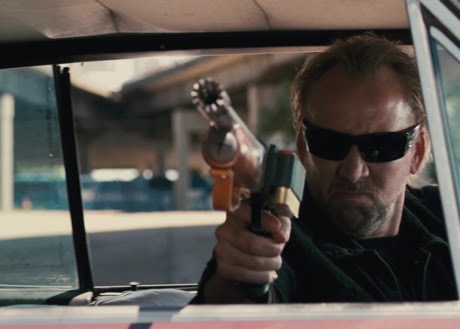
A surprisingly fun, self-aware enterprise, this relentlessly aggressive throwback to '70s car flicks such as Vanishing Point revolves around a near-psychopath as he attempts to rescue his kidnapped granddaughter from murderous satanists. The film never gets too much more complicated than that; aside from a couple of other characters, such as a beleaguered waitress and a mysterious "Accountant" in pursuit, the narrative is almost solely tied into the protagonist's quest for his missing granddaughter. The race-against-the-clock aspect, along with the cult aspect, reeks of '70s exploitation, and the film is definitely in that mold, eschewing logic for impact at any given moment. However, unlike similar exercises in action meta-awareness (like Shoot 'Em Up), this one actually knows where to draw its goofy/serious battle lines, with the slower moments having just as much dirty, grimey, pulpy energy as when it's at its most kinetic. That is not to say the action is not up to snuff; bullets fly at the screen, sex is rampant, and, for a film of this budget, the car stunts are surprisingly large-scale and well-rendered. And the cast, not an Ocean's 11 ensemble by any means, is wonderfully game.

I had read, prior to seeing the film, that Nic Cage plays against his strengths in this, going for a "Man With No Name" vibe, as opposed to his own patented explosivity; I call bullshit on that. While he is not screaming "It's murder! MURDER! And you're all guilty! GUILTY!!!", he is definitely aware of the silliness of the production, and takes his character to various extremes, but never condescends to the material; if I had to guess, I'd say this and Kick-Ass were more the kind of work he'd like to be doing than Sorcerer's Apprentice and Season of the Witch. As his waitress cohort and co-lead, Amber Heard is vicious, vivacious, and all sorts of awesome, giving this role a decent amount of humanity, and never once seeming like a desperate wannabe starlet running away from pyrotechnics. She has consistently turned in strong work in all that I've seen her in, but if she plays her cards right, Heard could easily make a career as a tough action heroine, sexier than Michelle Rodriguez and more fiery than Angelina Jolie. Billy Burke (who I recognized from Jane Austen's Mafia) is an effectively eerie villain, and David Morse shows up in an extended cameo as a friend of Cage, but the real highlight of the acting department is William Fichtner. Instantly recognizable, but elusively eclectic, Fichtner all but steals the film as the Accountant, seemingly toying with everybody in the film; neither a hero, nor a true villain, his character exists only to toy with civilians and to increase the stakes for Cage, both of which he does with a great sense of relish that I hope to see more of from the talented actor. He really has established himself as a modern day Warren Oates, or Elisha Cook, Jr., killing it in talented directors' work without ever worrying about being typecast or overexposed (remember his opening scene in Dark Knight?).

Highly Recommended for anyone who thinks that they'd like a movie called Drive Angry 3D starring Nicolas Cage and Amber Heard. Or for anyone who has ever said to themselves, "You know? They really don't make 'em like Vanishing Point anymore." I have. And they did.

Thursday, May 5, 2011

Super (2011)

Pitch-black, take-no-prisoners satire about a societal malcontent who, after his wife leaves him, goes on a quest to become a superhero in order to "free" her from the man she's shacked up with. The tone here is very bizarre; decidedly not a straightforward comedy, nor a bizarre melodrama, the mood never settles into something easily digested, nor easily explained. More than his previous feature, Slither, James Gunn invests the film with his anarchic roots with Troma Films, focusing, in nearly equal parts, on both the grotesque and the heartfelt, the benign and the macabre. He throws you off with the casting, as the presence of Rainn Wilson and Ellen Page as the principals suggesting some sort of detached hipster irony that never comes, leaving you not only emotionally bare from the events on screen, but doubtful that there was anything "genuine" worth getting worked up about. It is a very brave, unique mood for the movie to sustain, and it is, actually, the most noteworthy aspect of the film.

The cast is bolstered by the primary duo of Wilson and Page as the wannabe superheroes. Wilson, in particular, seems thoroughly immersed in the material, and shows a selfless dedication that very few superstars tend to show in their own star vehicles. Page is hilarious and, surprisingly, likable as the feisty, overexcited comic book geek, Liv Tyler is doomed and sympathetic as Wilson's wife, and Kevin Bacon, as the villain, is delightfully smarmy and baffling. In smaller parts, Gunn's Slither buddies Michael Rooker and Nathan Fillion are pitch-perfect, and The Wire's Andre Royo gets in some good lines as Wilson's coworker. Ruining much else of the movie would be a disservice to its effect; I had not seen any trailers for the film, and thus, was definitely impressed by a number of the films surprises. Just don't think this is some hipster comedy version of Kick-Ass, 'cause (maybe unfortunately) it's not.

Recommended to fans of out-there, no holds barred black comedies (read: TROMA) or Rainn Wilson, who, if he does nothing as prolific for the rest of career, can always use this performance to show what he's capable of as an unconventional, intense leading man.

Wednesday, May 4, 2011

Penn & Teller Get Killed (1989)

Simultaneously a madcap farce and a commercial for Penn & Teller's stage act, this black comedy has the titular duo of magicians running away from psychopaths after Penn states, on television, how exciting he'd find it if men were out to kill him. The narrative is treated as importantly as the duo, with their detached wit, treat anything, that is to say, not at all; once the initial conceit is established, the film is, essentially, a revolving door of scenarios, characters, and magic acts tenuously held together with scenes of Penn & Teller facing imminent death. There are a number of allusions to their stage personas, obviously egging you on to pursue their further work: several tricks are revealed to the audience, Teller has a showy response to cornier, "rabbit-in-the-hat" magicians, and many of Penn's particular sensibilities and interests are highlighted, seemingly for no narrative purpose. The two are funny, but Teller comes out looking better in the end because a. his endearing appearance is more suited for film comedy, b. his physical humor and sense of timing are impeccable, and c. the majority of Penn's lines are contrived, terrible, and often contradictory. His "romantic interest," if you could call her that, is hokey and obviously invented, and their scenes together are a fantastic drag. David Patrick Kelly, as the main psycho out for Penn & Teller's blood, is actually hilarious in his short screen time, but the convoluted "plot" often leaves him without a clear motivation for his character. The ending, with its final reveals and dark punchlines, is actually the most noteworthy scene of the film, with its moral and thematic ambiguity, its relentless bleakness, and its progressive, over-the-top tone, unmatched at any other point in the film.

Skip It, save for diehard fans of late '80s dark comedies or Penn & Teller. This one was directed by Hollywood legend Arthur Penn; this clumsy, directionless piece of work doesn't exhibit his talents.

Saturday, April 16, 2011

Scream 4 (2011)

A treat for horror fans, this 10-years-later sequel follows up on main characters, Sidney, Dewey, and Claire, who all happen to be in Woodsboro when a copycat Ghostface killer begins capping off local teens. The opening 5 minutes immediately set the tone for the rest of the film, with a plethora of meta cross-referencing, self-consciously false scares, and envelope pushing, genuinely surprising kills. Kevin Williamson, returning to the franchise after letting Wes Craven and Ehren Kruger nearly ruin the franchise with the yuck-yuck ridden Scream 3, brings the self-awareness of the originals full-circle with the entire cast, rather than just Randy, being in on the joke; the film gets a lot of tension out of the potential victims never being quite sure whether they are truly being stalked or being pranked by someone homaging the "Stab" series (the within-the-film adaptations of the "true" events of Woodsboro). The trends in modern horror are acknowledged, with one scene name dropping the majority of recent horror remakes, and the characters constantly debating whether they are in a sequel or a reboot (Williamson gets a great moment out of the line "Number one rule about remakes...don't fuck with the original.") Every time my date (or I) jumped out of her seat, it reminded me just how good Wes Craven's work can be when he's on point; there are many, many genuine surprise moments in the film, and they never feel tacked on, cheap, or desperate.

Like the originals, this one has an all-B+-star cast. Aside from returning leads, Neve Campbell, David Arquette, and Courtney Cox (who looks, and acts, terribly), Hayden Panetierre, Emma Roberts, Rory Culkin, Marley Shelton, Alison Brie, Anthony Anderson, Adam Brody, and Mary MacDonnell all have moderate-to-central roles (Panetierre, Shelton, and, surprisingly, Anderson are the most memorable). However, one of the highest compliments I can pay this entry is that it affirms, finally, that Sidney is ostensibly the heart and soul of this franchise. There is a scene where she tells a bereaved character "You know how people always say they know how you feel when they don't? I know how you feel." It would not work if her performance as Sidney had not been consistently immediate and real since the first film, and because of Campbell's repeated dedication to a role many other actresses would blow off as genre fluff, that moment, and a number of others like it (not to mention the otherwise-contrived scene in Scream 3 where she discovers the movie set version of her childhood home) are touching in a way not seen in many teen-centric horror films. When she used to land a kick or punch into the killer, keeping him off her, we used to laugh at the killer's klutziness; now, we cheer for Sid's undying survival skills. The attention given to her character, along with the relative fun of the aloof local teens (the film geeks, while obvious and overplayed, get their fair share of zingers), raise the film above the level of, not only its direct predecessor, but of a good amount of the original horror films of the past decade.

My qualms with the film are few, and far between, and they are mostly concerned with the treatment of Gale Weathers, the vaguely "reshot" look of the final scenes, and some of the shoehorned in film geek banter (Panetierre's "wannabe" film geek gets more pathos and humor than the "real-deals"). The tone, the scares, the laughs, the acting, the cameos, and the buildup are all top-notch, and make this a genuine rarity: a decade-plus later sequel that manages to not only capture, but expand on, the themes of the original.

Recommended for fans of the Scream franchise, or of more self-aware, "meta" (the word gets thrown around a lot, in jest) horror films. I was worried that, after 14 years, Williamson's self-aware jargon would be tired, pathetic, and out-of-touch. I stand, very gladly, corrected.

Wednesday, April 13, 2011

Death Note II: The Last Note (2006)

The sequel to 2006's live-action manga adaptation, this entry tells the contuining story of Light, who uses the Death Note to kill whomever he wishes by merely writing their name within its pages, and L, the gifted, intuitive cyberdetective obsessed with uncovering his identity. Without ruining the last film, the ending implied that there would be a sort of team-up between the two characters, and this film largely revolves around the implications of that partnership, from both sides. While L is nearly certain that Light is the enigmatic "Kira," as he is known, he is continuously thwarted by Light's ability to use the constituents of the book to his advantage. Meanwhile, the rest of the world reacts, in various ways, to Kira's unrelenting presence in the media, along with the arrival of, what seems like, another Death Note into the hands of another "Kira."

As it is more directly bound by plot and specific characters than the last installment, this follow-up is not quite as thematically ambitious as its predecessor, and does not focus on the societal impact of Kira's actions as much as their effect on the familiar characters from part 1, and two crucial new female characters. Where the last one played with the viewer's emotions in regards to Light, and how he simultaneously expressed empathy and ruthlessness through the Death note, this one paints the characters in broader strokes, and makes less of an effort to keep their motivations behind their actions ambiguous. However, in exchange, there is more an emphasis on immediacy and suspense, and, after a full movie setting up the duel between L and Light, it is a blast to see their rivalry take center stage while the global ramifications of the Death Note pile up around them. The fundamental differences in their characters are more highlighted this time around, and their strained, yet somewhat understanding interplay is the main joy of the film. Also along for the ride, with further extrapolation, are Light's police official father, his apple-eating guardian god-of-death, Ryuk, and L's loyal handler, Watari; one of the advantages of the two films being filmed with such little time-lapsed is that not only is the entire cast present, but everyone looks and acts exactly as they should, considering the plot begins mere moments after the original's ending.

Highly Recommended for fans of the original, or of ambitious, morally ambiguous manga or cinema. I was not as taken off guard with this one as I was with the first one, but that is only due to my lack of awareness of the series prior to that viewing; in terms of sequels, I kept waiting for this one to show the dirt under its fingernails from playing in its own playground for too long, but the film managed to ride the momentum provided by the original until its thoroughly satisfying wallop of an ending.

Sunday, March 6, 2011

Burke & Hare (2010)

Clever, pitch-black English comedy about two Scottish peasants who begin selling fresh dead bodies on the black market in 1840's Edinburgh. Simon Pegg and Andy Serkis play the titular duo, who, after failing to make it as street vendors and hustlers, discover an enterprise to be made out of the local university's desperation for fresh cadavers for the purposes of public autopsies. They begin by hunting down the near-dead and waiting out their demise, but soon, they find that, to meet demand, making cadavers out of live subjects (read: murder) would be a more business-savvy approach. The film is nasty; aside from the macabre subject matter, the Scottish setting is grimy, foggy, and dirty, even in the halls of the Scottish aristocracy. However, the performers, and, especially, director John Landis do much to keep the tone lively and energetic, infusing the project with a less contemporary, more fearless style of comedy that, I'm sure, contributed to the film's current floundering for U.S. distribution (as far as I've heard).

Pegg is his usual sympathetic, blustery self, while Serkis, in a rare live-action leading man role (he's best known for mo-cap work as Gollum in LOTR and King Kong in...King Kong), creates a distinct character out of what could've been a typical cynical, money-mad barker type; I hope his comic, and, surprisingly, romantic (a flirty scene with him and Jessica Hynes was my favorite moment in the picture) sensibilities help him attain more actual on-screen work. Hynes, Pegg's costar from Spaced, outshines her former cohort in terms of energy, timing, and panache, but in her particularly British fashion, which may not translate to further work on this side of the pond (a shame). As the dueling aristocratic doctors, Tom Wilkinson(!) and Tim Curry(!!!!) are wonderfully in tune with the material, playing it straight and reveling in the comic bleakness when the situation calls for either. Isla Fisher, while initially distracting, is a serviceable femme fatale of sorts, and does not grind the picture to a halt like a more sympathetic, less merciless approach would have done. Cameos by British talents permeate the picture, with names like Stephen Merchant, Bill Bailey, and Christopher Lee popping up for, sometimes, just a line or two, along with the various directors Landis called in for his traditional filmmaker walk-ons (Ray Harryhausen, Costa-Gravas, among others).

The wonderful cast aside, it is John Landis who steals the show from off-camera. After a decade(!!)-long absence from narrative film, he pulled a Frank Oz and went to England where, it seems, the creative control allowed to him, due to his undeniable track record, the ability to render the clever script into fully-formed and well-devised comic set-pieces, which, while being more obvious and showy than the more recent, Apatow-led style of comedy, rings as true as the finer moments in his classic films (John Landis classic film rollcall for the unitiated: Kentucky Fried Movie, Animal House, The Blues Brothers, Trading Places, Spies Like Us, Three Amigos!, Coming to America). His style allows for both high-concept black comedy blunders and more restrained, human moments that never even border on schmaltz or corniness. While I am not hopeful for this film's stateside returns (the mix of jet-black comedy and the grimy Scottish setting will probably turn off most Americans), I am grateful that Landis was allowed even just one more chance to prove his last few pictures (Blues Brothers 2000, The Stupids, Beverly Hills Cop 3) were not the best he could do.

Recommended to fans of black or British comedy, John Landis, or the eclectic cast; for me, the dual joy of seeing John Landis and Tim Curry doing memorable big-screen work again would've been enough to warrant recommending the film, but the whole project is, while slightly less effective than Pegg's recent, more heartfelt Paul, an unabashed success.

P.S. WATCH THE CREDITS for a fairly genius, wordless epilogue.

Tuesday, November 30, 2010

No Such Thing (2002)

Interesting, but sprawling fable about a young journalist who, while looking for her murdered fiancee in Iceland, discovers a surly, yet inexplicably American-accented monster, and, of course, befriends him. Sarah Polley plays the lead character, an ambitious young reporter who works for power-hungry, cold-hearted cliche Helen Mirren. She convinces Mirren to let her search for her fellow reporter husband by claiming it to be a viable human interest story. She is led to a small Icelandic village where all the bumbling locals are terrified of the nearby monster. They knock her out and send her to his lair in an abandoned missle silo. And their magical, illuminating friendship begins, leading them both on a path of self-discovery that will change their lives forever.

While my tone may imply that this film is a rudimentary, cliched turd of a film, I actually liked it. The director, Hal Hartley, has a way of portraying even the most rudimentary and arbitrary of scenes in such a way that it actually feels original; that Wes Anderson way of playing familiar elements so on the nose, that they come out the other side and magically become fresh again. Things that shouldn't work, do work, such as Helen Mirren's been-there-done-that bloodthirsty media magnate, the coo-coo mad scientist with a history with the monster, and, especially, the monster, himself. Played by vet character actor Robert John Burke under pounds of excellent, inventive makeup, he is a tortured, cynical, bitterly alcoholic pile of misery, in constant pity for himself for being forced to live alongside humans for eternity; Frankenstein by way of Bukowski. If his familiar American sense of humor did not exceed Hellboy proportions, this film could've been a disaster. As is, he keeps the film imminently watchable and entertaining, even if the end result doesn't amount to very much. Hartley is too content portraying things for what they are, disregarding truckloads of potential subtext, and neglects to do anything particularly deep or subversive with the material.

Slightly Recommended for fans of Hal Hartley or the cast, which also includes Julie Christie as a sympathetic doctor. This lacks the immersive, meticulous perfection of Hartley's Henry Fool, but it contains more original and inventive touches than that films sequel, Fay Grim.

Monday, September 20, 2010

Panic (2000)

Low-key hitman mid-life crisis film about an assassin who tenuously begins relationships with therapy and a young, volatile bisexual. This is not a huge budget film, but the actors make the dialogue and relationships sing; William H. Macy and Donald Sutherland, as the hitman and his gangster father, have a pitch-perfect dynamic, and the better parts of the film are concerned with their strained relationship, and Macy's repressed conscience. The therapy sessions, with John Ritter as the befuddled shrink, are not as provocative as similar setups in Grosse Point Blank or The Sopranos, but they have an effortless charm due to Macy's deadpan delivery and Ritter's constant discomfort toward his role as a sort-of accomplice to murder. Macy's home life, with Tracy Ullman as his wife and their grade school son, is well-presented as average, but warm, and several scenes with Macy relating to his son at his bedside achieve a surprising amount of poignance. However, the central love story, with a tick-filled, neurotic performance by Neve Campbell as a flighty 23-year old who is attracted to Macy, falls flat, is devoid of logic or chemistry, and does not have the maturity and oddball tone of the rest of the film; their banter is the kind of juvenile narcissism the rest of the dialogue would acknowledge only in jest. Luckily, the film is not as dependent on the romance angle as I worried it might have been, and the other relationships in the film are well-defined and presented enough that they balance out the missteps with Campbell's character.

Recommended for fans of Macy, Sutherland, or of similar hitman dramedies like Jerry & Tom or Analyze This. I remember this one premiering on cable (Cinemax I think) back in the day; while I see how this got swept under the rug in lieu of Analyze This and The Sopranos, it is breezy, yet distinctive enough to be worth seeking out.

Saturday, September 4, 2010

Machete (2010)

Appropriately crazy and over-the-top feature-length adaptation of the fake trailer (that's gotta be a first) revolving around a racist-killin' MexiCAN who gets framed, and, naturally, must seek revenge. The style of this Robert Rodriguez (co-written, co-produced, and co-directed) flick is strongly evocative of B-grade '90s action pictures, and not in the most obvious, corny ways; Rodriguez wants this to be able to play as a straight, gung-ho, fuck yeah Mexican action picture as well as a subversive nod to the conventions of the genre. The action is absurd, but horrifically comic, and it pleases the audience as well; the audience I saw it with hooted and hollered throughout. The cast is, mostly, a delight: aside from the badass Danny Trejo as the titular Machete, you have a mix of modern day eye candy (Michelle Rodriguez, Jessica Alba, and Lindsay Lohan) and older, '80s era stars (Jeff Fahey, Robert DeNiro, Don Johnson, and Steven Seagal) hamming it up and having a blast. Unfortunately, much of the script revolves around Alba's boring-sauce INS agent, and her scenes drag down the momentum of the film, but the rest of the cast (save for Lohan) picks up her pace, especially Seagal, who makes his first major villain turn a fresh, original turn from him (and it shows he has a sense of humor, which is nice). The stronger emphasis on humor here is what differentiates this from the recent action-flick homage, The Expendables, and it's also what makes this film a more memorable experience altogether.

Highly Recommended for fans of high action and/or the more harder-edged output of Robert Rodruiguez (i.e. Desperado, From Dusk Till Dawn). The best thing I can say about this movie is that every shot that I remember from the trailer ended up the film, and I definitely didn't think that shit was possible; I once again think to myself that Rodriguez may be one of the smartest men in show-business right now.

Tuesday, August 24, 2010

Piranha 3D (2010)

Filled to the brim with gore and nudity, this is a horror film that knows its audience, and wholeheartedly respects and indulges what they are there to see. The plot is Jaws, straight-up: a lakeside community discovers killer piranha in their waters the same week as the yearly town-driving spring break. Elizabeth Shue is Roy Scheider (complete with an homage to the shot where he sees the dead boy), Adam Scott is Richard Dreyfus (who, himself, cameos in the intro), and Ving Rhames ends up as Quint, in more ways than one. The protagonist is Shue's teenage son, who gets involved with a Girls Gone Wild-type video crew to win over a prospective girlfriend; this is all stock horror filler material, but it actually proves entertaining, due in no small part to the crude presentation of the crew (including Jerry O'Connell and Paul Scheer) as lecherous, near-psychotic perverts. But the best appearance in the film belongs to Christopher Lloyd, explaining the impossibility of these ancient fish appearing in the lake with 1.21 jigawatts of his trademark energetic delivery; the filmmakers confidently set up a sequel where he may get a larger role, and that is definitely a motivator to follow this franchise. The fish carnage is bountiful and wonderfully over-the-top, but the films tight budget shows in some fuzzy, shaky gore shots. The films greatest achievement is its simultaneous self-awareness and genuine horror tension; the laughs and scares come at an equal ratio, making for a fun, breezy horror film that nails, as the critics have said, the mood that films like Snakes on a Plane have been shooting for for years.

Highly Recommended for horror buffs, or anyone else who loves gore or boobies or Christopher Lloyd (basically everyone, right?).

Tuesday, June 22, 2010

The Hot Spot (1990)

Steamy, if thin neo-noir about a drifting used-car salesman, a teenaged sexpot, and a sexually aggressive southern belle. Don Johnson is the lead, who gets bounced around between his flirty, virginal relationship with Jennifer Connelly's sweet 19-year old and Virginia Madsen's blonde bombshell trophy wife (of his boss, no less). Connelly is gorgeous, but is, expectedly, too subdued, leaving the true sparks flying between Johnson and Madsen. Aside from being ideally sweaty-handsome, Johnson is a fucking trooper in trying to play his inexplicable, plot-dependent character straight, and not over the top, and keeping him a somewhat grounded and identifiable protagonist, despite his unjustified behavior throughout; Johnson deserved more roles like this when he looked like that (I'm counting down the seconds till Machete brings Crockett and Seagal back to me). But the true star of the show is Madsen. For the first time, I see the evidence of her bloodline with brother Michael, 'cause she's all sorts of crazy-sexy-cool in this one. Her backstory is thin, so she makes her character a large, smothering sexual figure, one that would have been considered a Catherine Tramell spoof had this been released after Basic Instinct. Her performance takes her character very far over the edge, but her dynamite looks at this time completely back it up, and it is not a stretch at all to see someone like Johnson's character losing his marbles over that appealing of a sexual aggressor. The supporting cast, featuring strong character actors William Sadler and Charlie Martin Smith, gets short-changed, with all the focus being on the nonsensical love triangle. However, the style in Johnson and Madsen's scenes are so strong, the rest of the film kind of falls into place around their relationship, instead of distracting us from it.

Recommended for fans of neo-noirs, Don Johnson, Virginia Madsen, or Jennifer Connelly's (gratuitously shown) breasts. This one falls in the realm of Palmetto or Wild Things, in terms of hot, southern, sexually-charged noirs, but definitely more the former than the latter in terms of quality (no 3-ways here, gents).

Sunday, June 20, 2010

From Paris With Love (2010)

Stupid, but mildly entertaining buddy flick about an ambassador's assistant and an unhinged psycho American spy tearing up Paris in search of terrorists. Johnathan Rhys-Myers is the assistant, a dork of the McAvoy-Wanted caliber (similarly worthless and boring as well) who has his domesticated, girlfriend-loving world rocked by Travolta's bald badass. It surprises me to say this, but Travolta is really the only reason to see this movie. Luc Besson's script sucks and Pierre Morel stages action boringly for the first time in his career, but seeing Travolta shoot, cuss, and overact his way through this film is a reminder that the Pulp Fiction-Face/Off Travolta's still in there somewhere; honestly, I forgot he was capable of the kind of energy and responsiveness on display here. His look is too much; someone should have told him that he could have the bald head or the garish Chrome Hearts getup, but he couldn't have both. But he still steals the film effortlessly, and if he had the film to back him up the way Liam Neeson had Taken, he'd be back on top of the A-list before you could say "Old Dogs."

Slightly Recommended for Travolta fans or junkies of Besson's Paris-set action flicks. I wouldn't dare compare this to the best of those, especially the other Morel pictures, but it falls roughly into that mold.

Wednesday, June 16, 2010

Big Fan (2009)

Intimate, poignant character study of a diehard New York Giants fan who faces his own obsessive habits when he has an unfortunate run-in with the star QB. Patton Oswalt is the fan, Paul, who lives with his mom and works out of a parking garage toll-booth, where he typically spends his evenings coming up with stuff to say on his favorite late-night call-in sports show. He goes to the Giants games, but watches them from the parking lot. His devotion clearly connected with Oswalt's own geekdom, for he plays the role magnificantly, giving Paul a sort of dignity; while others laugh at him, his team is the equivalent of his career, or his family, providing him all the validation he needs as a person. Kevin Corrigan, as his partner-in-crime and loyal friend, is more straightforwardly comical in his dim-bulb idolatry of not only the Giants, but Paul's devotion to them as well. This is a film in the vein of (but not equal to) Observe and Report (which also features Patton), in its focus on character over plot, and the melancholy miseries that plague our everyday lives instead of the joys that interrupt them.

Highly Recommended for fans of smaller, more offbeat comedies and Patton Oswalt. I expect great things of Remy the rat now.

Wednesday, April 14, 2010

The Good The Bad The Weird (2010)

Fun, if unremarkable Korean western that sustains an unremarkable plot with a breezy pace and exciting scenarios. The story is basically a retread of The Good, The Bad, and The Ugly; a drifting badass and a thieving buffoon team up to find a lost treasure, with a traitorous mercenary hot on their tail. While the film apes Leone's story beats, it does not even try to appropriate his style; the long, deliberate takes of Leones are replaced by quick pans and cuts that keep the film moving along quickly enough to look past its faults, namely the soullessness of characters based on better, more nuanced performances. Aside from "The Weird," played by Chan-Wook Park mainstay Song Kang-ho, the central roles are played, for the most part, at face value, with little subtext or mystery present until the final scene, which actually does manage to impress. The set pieces of the film are very well executed, if a tad contained, and the action comes often enough that the hackery of the script rarely catches up with the film. However, even when compared with something like Sukiyaki Western Django, which took its ridiculous plot to even further visual and kinetic heights, it does not make for particularly relevant or compelling viewing for most film goers.

Slightly Recommended for fans of goofy westerns a la Sukiyaki Western Django. This is, as I should've guessed, a clear case of style over substance. If that's your bag, especially in relation to westerns, this is a fun way to spend 2 hours and 10 minutes. Otherwise, there are better movies of the sort worth seeking out.

Tuesday, April 13, 2010

Picking up the Pieces (2000)

Lame, yuck-yucky DTV comedy about a missing hand, linked to a murder, that suddenly provides miracles for the citizens of a New Mexico town. Woody Allen plays a Texan butcher who, after killing his wife out of jealousy toward her many infidelities, accidentally scatters her body parts in New Mexico. He accounts for all of them except a hand (flipping the bird, no less), which is found by locals, and soon, very apparant, and very real miracles start occuring; the blind can see, the crippled can walk, David Schwimmer gets the girl, etc. The plot doesn't really extend beyond that, with the remainder of the story involving mix-ups and confusion over the hand, it's true meaning, and it's real point of origin (they think it's the Virgin Mary's). This New Mexican, Catholic, Virgin Mary bullshit betrays the sophistication of the cast and reveals the film for what it is; a pathetic attempt by a Mexican director (Alfonso Arau of Like Water Like Chocolate) to make a cross-over mainstream comedy without leaving his comfort zone. Like Ricky Gervais' The Invention of Lying, the religious satire only extends to establishing that it can, in fact, exist, and not that it is misguided, or, dare I say, shouldn't exist. So within this ramshackle, shitty looking dirt NM town, we get people like Allen, Kiefer Sutherland, Joseph-Gordon Levitt, Cheech Marin, and Sharon Stone (as the hacked up wife) running around, impotent to make the movie funnier (save for Allen, who simply CAN'T be unfunny in a narrative film, no matter how much he tries). The familiar faces do help this pill of shit go down easier, but by the time the shark is jumped and 3 priests from the Vatican arrive, played by Andy Dick, Fran Descher, and Elliot Gould (amusingly channeling Maximilian Schell), it just starts making the finer actors in the bunch look bad (particularly Kiefer and Gordon Levitt).

Skip it, save for diehard Allen aficionados who could care less about content but would get off on seeing him run around the desert in a cowboy hat. I heard a lot of terrible things about this one, and the cast made me ignore it; now I remember why I don't get distracted by pretty faces if the body smells like Mexican horseshit.

Crimewave (1985)

Little-seen slapstick/noir directed by Sam Raimi and written by the Coen Brothers, without matching up to their then-standard of excellence. The plot, a hodgepodge of noir cliches, involves an insurance plot, two grotesquely over-the-top hitmen (one played by Brion James), and a nerdy stooge, who tells us his story from the electric chair. I feel the same way about this plot as I do Blood Simple's; it really seems to exist just to show some set pieces off, rather than the other way around. Aside from a running subplot about Bruce Campbell as a "heel" trying to pick up women, there is very little in the story, plot, or dialogue that sustains interest. Whether this is due to the amateur nature of the script or meddlesome studio tinkering, who knows. However, the real interesting aspect of the film is the staging. The film is set up as a noir, but plays like a slapstick, and in that sense, it almost works. There are big comic set-pieces, and Raimi's touch actually pulls a good amount of them off, particularly a sequence where a game Louise Lasser runs away from a hitman in "The Safest Hallway in the World." His Three Stooges influence is more on display here than any of his horror work, and it is refreshing to see him using those talents in a genuine comedy. That being said, other than that and his use of Campbell in a supporting role (who nonetheless steals the whole fucking show, seemingly out of spite), unfortunately, the ingenuity of his and the Coen Brothers would be better utilized in the coming years than this one.

Slightly Recommended for big Sam Raimi or Bruce fans, but latter beware; he bites it about 2/3rds in, and the movie can't prove its mettle without him. There's a reason this isn't a hotter commodity online, but it really isn't that bad, and, if you are interested, worth checking out for some truly original and cool comic staging.

Wednesday, April 7, 2010

Dead Fish (2008)

Cute, if slightly tepid British crime yarn about a hitman and a young lad in love who accidentally switch phones, and the mayhem that ensues. The plot, a collection of contrivances and goofy, colorful characters, all very reminiscent of Guy Ritchie's crime flicks, is most certainly not an appealing factor here. In fact, the biggest thing the film has going against it is that it feels, more or less, like a bunch of shit happening simultaneously without any real, organic sense of cohesion. What IS actually pretty cool and watchable here are the performances. Gary Oldman plays the hitman with a great, surprisingly coiled attitude that is a refreshing change of pace from his typical loud, explosive villain routine. He actually provides the film with a bit of genuine romantic substance that the writing does not nurture in the slightest. Some bloke named Andrew Lee Potts plays the schmuck that switches phones with Oldman, and unwittingly integrates himself into his life, and he's a solid, likeable lead, but he's completely overshadowed by the original love Guru Jimi Mistry as his stoner buddy Sal. Billy Zane and Karel Roden play bumbling hitmen on the hunt for Potts (remember what I said about Guy Ritchie), but aside from Zane's delightfully stuffy attire and demeanor, their scenes have little to write home about and could have easily been cut from the film. And Robert Carlyle basically combines his performances in Transpotting and Formula 51 for his loan shark character, stealing the film in his few scenes with a never-ending spew of verbal abuse and an overarching sense of pragmatic entrepreneurship. The circus-like procession of interesting characters is fairly fun, but the intensity level is not high enough and the events that transpire never deviate far enough from convention to truly be memorable. That being said, there is an interesting, unconventionally toned-down visual aesthetic to the film, and it gives the film more leverage than I believe the script deserved.

Slightly recommended for fans of British gangster films a la Guy Ritchie or Formula 51 (aka The 51st State). I started this one thinking it seemed to be a lost brother to those films; but a distinct creative lack of ambition keeps this one a lesser relative.

Sunday, February 14, 2010

He Was A Quiet Man (2007)

Provacative, pitch-black DTV comedy about a repressed office worker and his unsatiable craving to massacre his workplace, bolstered by a fantastically nebbish Christian Slater in the lead. He spends his cubicle-dwelling days planning the demise of those who berate and trivialize him every day, staring at his revolver while assigning a bullet for each person. He's just about to carry out his actions when another lowly office employee takes the initiative and plugs a roomful of people, and when Slater realizes his office crush took a slug in the back, he "saves the day" and offs the other nutjob, looking like a hero. He gets a promotion, newfound respect, and the companionship of a wounded office worker who feels in his debt. But his psychotic tendencies, manifested by fish that he hallucinates feeding him orders, live on to cause him stress and alienation, building towards a breaking point Slater knows is coming and cannot avoid. The hopelessness of Slater's character, and the actor's willingness to make the character a completely unromantic nutcase (unlike some of his previous characters) make this film worth watching. When he begins his rags to riches story, and the love story element seems to seep in uninvited, the film could easily become a cliched, trite indie mess, but you know that Slater's character is still quite off his rocker, and could ruin it all in a heartbeat. His sweaty, high-strung to the point of paralysis performance, along with a wonderfully smarmy one by William H. Macy as his new, higher-up boss, keep the film from settling in to long and making you comfortable; you know this guy well enough to know he's capable of terrible things, and it'll be an uphill struggle to see him get to a neutral zone in his life where he can be content with what he has.

Recommended for fans of black office comedies or Christian Slater. This one had nowhere to go but DTV; it is too dark, twitchy, and depressing for most audiences, even those for darker comedies a la Office Space. But hopefully the presence of stars Slater, Macy, and Elisha Cuthbert will keep this relatively watched in years to come.