Showing posts with label Thriller. Show all posts

Wednesday, May 11, 2011

Drive Angry (2011)

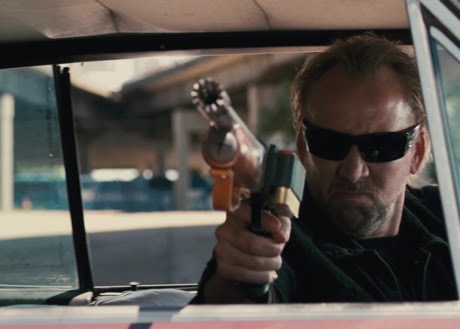
A surprisingly fun, self-aware enterprise, this relentlessly aggressive throwback to '70s car flicks such as Vanishing Point revolves around a near-psychopath as he attempts to rescue his kidnapped granddaughter from murderous satanists. The film never gets too much more complicated than that; aside from a couple of other characters, such as a beleaguered waitress and a mysterious "Accountant" in pursuit, the narrative is almost solely tied into the protagonist's quest for his missing granddaughter. The race-against-the-clock aspect, along with the cult aspect, reeks of '70s exploitation, and the film is definitely in that mold, eschewing logic for impact at any given moment. However, unlike similar exercises in action meta-awareness (like Shoot 'Em Up), this one actually knows where to draw its goofy/serious battle lines, with the slower moments having just as much dirty, grimey, pulpy energy as when it's at its most kinetic. That is not to say the action is not up to snuff; bullets fly at the screen, sex is rampant, and, for a film of this budget, the car stunts are surprisingly large-scale and well-rendered. And the cast, not an Ocean's 11 ensemble by any means, is wonderfully game.

I had read, prior to seeing the film, that Nic Cage plays against his strengths in this, going for a "Man With No Name" vibe, as opposed to his own patented explosivity; I call bullshit on that. While he is not screaming "It's murder! MURDER! And you're all guilty! GUILTY!!!", he is definitely aware of the silliness of the production, and takes his character to various extremes, but never condescends to the material; if I had to guess, I'd say this and Kick-Ass were more the kind of work he'd like to be doing than Sorcerer's Apprentice and Season of the Witch. As his waitress cohort and co-lead, Amber Heard is vicious, vivacious, and all sorts of awesome, giving this role a decent amount of humanity, and never once seeming like a desperate wannabe starlet running away from pyrotechnics. She has consistently turned in strong work in all that I've seen her in, but if she plays her cards right, Heard could easily make a career as a tough action heroine, sexier than Michelle Rodriguez and more fiery than Angelina Jolie. Billy Burke (who I recognized from Jane Austen's Mafia) is an effectively eerie villain, and David Morse shows up in an extended cameo as a friend of Cage, but the real highlight of the acting department is William Fichtner. Instantly recognizable, but elusively eclectic, Fichtner all but steals the film as the Accountant, seemingly toying with everybody in the film; neither a hero, nor a true villain, his character exists only to toy with civilians and to increase the stakes for Cage, both of which he does with a great sense of relish that I hope to see more of from the talented actor. He really has established himself as a modern day Warren Oates, or Elisha Cook, Jr., killing it in talented directors' work without ever worrying about being typecast or overexposed (remember his opening scene in Dark Knight?).

Highly Recommended for anyone who thinks that they'd like a movie called Drive Angry 3D starring Nicolas Cage and Amber Heard. Or for anyone who has ever said to themselves, "You know? They really don't make 'em like Vanishing Point anymore." I have. And they did.

Thursday, April 28, 2011

Blown Away (1994)

Half-Patriot Games, half-Speed, this handsome, but flat thriller involves two Irish ex-pats, one a bomb squad detective, the other a mad bomber, in a battle of wits in Boston. Jeff Bridges is the hotshot cop, the kind who rides a motorcycle and introduces himself to a potential bomb victim as "Dove...Jimmy Dove." He has decided to settle down and retire when a face from his past, Tommy Lee Jones' Ryan Gaerity, begins to blow up his colleagues in meticulously planned, diversionary bomb scares. Once he knows that Gaerity has specifically targeted him, he becomes obsessed with protecting his father, his bomb squad, his new bride, and her precocious little daughter.

You might be thinking this movie is, basically, an extended showdown between the two macho heavyweights, Bridges and Jones; unfortunately it's not. Much of the movie shows Dove defusing various bombs and traps left for him in advance by Gaerity, sometimes with some sort of note or visual accompaniment attached. They seem to have gone the Heat route, and treated each character as if they inhabited their own story, which would be great if the final overlap was appropriately satisfying; unfortunately it's not (unless you like goofy mid-90's man-wrasslin' scenes). But while Jones' story rides, primarily, on Jones eternal watchability (witnessing his ex-convict character discover the joys of hyper-Irish U2 is a true delight), Bridges is supported by a stellar supporting cast, including Forest Whitaker and Ruben Santiago-Hudson, as fellow bomb defusers, and real-life pop Lloyd Bridges in a phenomenal turn as his old man. A huge detriment to the film is the focus on Bridge's attempt at domestication with his new wife, Suzy Amis. The scenario is so contrived and cliched, with terrible, momentum-breaking dialogue ("Thinking about checking out?") that Bridges ends up being left in the cold, without a consistent character to hold on to; is he a tortured, redemptive warrior, or a battle-weary soldier looking to settle down (it is easier to dismiss Amis' bland, nonexistent performance as an indication of a decided lack of talent)? The bomb scare stuff is tense and fun, but the film continually takes time to focus on Bridges and Amis' home life, deflating any chance this film had of achieving a pace like, say, Speed. The dialogue is serviceable, and the Boston setting is used moderately well, but the main draw here are director Stephen Hopkins long, intricate bomb scares that are a joy to watch snowball and develop.

Slightly Recommended for fans of the cast and scenes where someone looks at a big bomb with a lot of wires and is determined to defuse it (i.e. The Hurt Locker, Lethal Weapon 3, etc.). Stephen Hopkins has done some terrific movies (The Life and Death of Peter Sellers, Judgment Night) and some alright ones (Predator 2, Lost in Space). This is one of the latter.

Wednesday, April 27, 2011

Perfect Blue (1998)

Haunting and surreal, this psychological thriller anime revolves around a pop star as she begins to take on serious film roles in an attempt to subvert her squeaky-clean image, and the resulting uproar that follows. Her manager begins to grow distant and disapproving, her most rabid fans feel betrayed and disillusioned, and the star, Mima, begins to have episodes of confusion where she fails to differentiate the shift in the tone of her performances from the changes in her actual, real-life psyche. More and more, the line between reality and fantasy blurs, and Mima reaches a point where she cannot distinguish real-life threats and her own personal demons.

The line between art and the artist is the focus here, as the main tension in the film comes from Mima's emotional and mental strain while attempting to expand her oeuvre into previously unexplored depths. Like Black Swan, this film shows how her commitment to achieving a perfectly realized, true performance leaves her so emotionally and mentally vulnerable that she seems almost predestined for confusion and hallucinatory nightmares. Her drive is her own worst enemy, and is that which alienates all of the previously stable forces that allowed her to ride her bubble-gum pop star image into stardom, which she now resents to the point of abandonment. As with his other works, Paprika and Millenium Actress, director Satoshi Kon is more concerned with his characters' internal mindsets than any clear, coherent narrative or structure. Unlike Paprika, the central conflict here is so engrossing and, surprisingly, contemporary (this came out more than a decade before Miley Cyrus tweeted her first nudie pic) that it transcends its trappings of reality and allows the dream-like framework to function in tandem with, and not against, the emotional content of the film.

Highly Recommended for fans of surreal, mature animation, or, specifically, Satoshi Kon. While I still prefer Millenium Actress, with its decades-long scope and delightfully twisty narrative, this is a more satisfying and moving piece than Paprika, which remains the better-known film.

Monday, April 18, 2011

Fade To Black (2006)

Atmospheric and lively, this contemporary noir revolves around Orson Welles as he acts in an Italian production, filming in Rome, while getting involved with a murderous plot. The narration, from Welles' perspective, immediately provides a real-life context for his character; his post-Kane fame (or infamy) has dwindled, and, although he can get jobs in these foreign co-productions, his Hollywood standing has long since been eclipsed by his former wife, Rita Hayworth, whose posters for Gilda are omnipresent even before Welles leaves the Roman airport. However, the Hollywood in-jokes, thankfully, do not permeate the picture, and soon after Welles exhibits some of his trademark magician's panache, bodies begin to pile up and the mystery becomes the focus of the plot; even before he is directly implicated as a possibile victim, Welles, disillusioned with both his career and the film he is making (humorous scenes show him, almost offhandedly, directing the film himself, as the hapless director can only nod in awe), sees it as a neccessity to get involved with the case in a sleuthing capacity. His driver, formerly a local policeman, assists him as they get deeper and deeper into the politics that may, or may not, have instigated these murders.

For a movie that was ignored in the U.S. the way it was, the film has a surprisingly prolific cast, who all turn in strong, invisible work. Diego Luna, of whom I am not a large fan, makes an intelligent and, surprisingly, tough sidekick, whose reserved demeanor provides a pleasant contrast from Welles verbal showmanship. Paz Vega, as the lead actress of Welles' film, makes for a gorgeous, mysterious femme fatale, while Christopher Walken is subdued, yet enigmatic as a CIA agent friend of Welles. But as Welles himself, Danny Huston turns in some of the best work I've seen from him, and carries the film on his shoulders. He is given the remarkable task of not only filling the shoes of one of the most identifiable and public figures of classic Hollywood, but also maintaining his role as an audience surrogate for the mystery plot, and he is more than up to the task. No doubt somewhat due to his father's relationship with Welles, he is thoroughly familiar with his verbal candor, his fierce, tactile intelligence, and, most of all, his undying cheekiness; we do not wonder, for a second, why this huge movie star is so weilling to put everything else aside and let the amateur detective in him take over. We discover the twists and turns of the local political history and intrigue through his eyes, which, like us, are far more concerned with entertainment and American expat bluster than the dismal state of post-WWII Italian infrastructure. His performance makes the character a larger-than-life, pretentious, yet naturally realized and open-minded protagonist that makes investigating the crimes at hand, with him as a surrogate, a delight.

Recommended for fans of the cast, especially Danny Huston, Orson Welles (who is both revered and nudge-nudgingly lampooned in the film), or foreign-set noirs, such as The Third Man, which this film, clearly, homages.

Wednesday, April 13, 2011

Death Note II: The Last Note (2006)

The sequel to 2006's live-action manga adaptation, this entry tells the contuining story of Light, who uses the Death Note to kill whomever he wishes by merely writing their name within its pages, and L, the gifted, intuitive cyberdetective obsessed with uncovering his identity. Without ruining the last film, the ending implied that there would be a sort of team-up between the two characters, and this film largely revolves around the implications of that partnership, from both sides. While L is nearly certain that Light is the enigmatic "Kira," as he is known, he is continuously thwarted by Light's ability to use the constituents of the book to his advantage. Meanwhile, the rest of the world reacts, in various ways, to Kira's unrelenting presence in the media, along with the arrival of, what seems like, another Death Note into the hands of another "Kira."

As it is more directly bound by plot and specific characters than the last installment, this follow-up is not quite as thematically ambitious as its predecessor, and does not focus on the societal impact of Kira's actions as much as their effect on the familiar characters from part 1, and two crucial new female characters. Where the last one played with the viewer's emotions in regards to Light, and how he simultaneously expressed empathy and ruthlessness through the Death note, this one paints the characters in broader strokes, and makes less of an effort to keep their motivations behind their actions ambiguous. However, in exchange, there is more an emphasis on immediacy and suspense, and, after a full movie setting up the duel between L and Light, it is a blast to see their rivalry take center stage while the global ramifications of the Death Note pile up around them. The fundamental differences in their characters are more highlighted this time around, and their strained, yet somewhat understanding interplay is the main joy of the film. Also along for the ride, with further extrapolation, are Light's police official father, his apple-eating guardian god-of-death, Ryuk, and L's loyal handler, Watari; one of the advantages of the two films being filmed with such little time-lapsed is that not only is the entire cast present, but everyone looks and acts exactly as they should, considering the plot begins mere moments after the original's ending.

Highly Recommended for fans of the original, or of ambitious, morally ambiguous manga or cinema. I was not as taken off guard with this one as I was with the first one, but that is only due to my lack of awareness of the series prior to that viewing; in terms of sequels, I kept waiting for this one to show the dirt under its fingernails from playing in its own playground for too long, but the film managed to ride the momentum provided by the original until its thoroughly satisfying wallop of an ending.

Wednesday, April 6, 2011

Battle: Los Angeles (2011)

Basically a very well-rendered, if not particularly imaginative, video game cut-scene, this actioner with sci-fi overtones concerns the military response to a hostile extra-terrestrial invasion, specifically on the coast of Los Angeles. While I disagree with Roger Ebert's half-a-star(!) review, I think he gave the movie too much credit by writing it a full-page review. This is not a full-page review type movie, because I doubt the execs ever gave a full page of notes during the whole show. This is a thin, thin, thin, thin movie, with terribly cliched dialogue, characters, and situations that even the most mildly educated cinephile will see coming a mile away ("Bye, Hoyt!"). The action is, until the end, pretty terrific, but it becomes obvious that the budget constrictions did not allow for ID4 or War of the World style carnage; even so, the more intimate battle scenes are nail-bitingly intense and well-choreographed. However, it does not fully redeem the grade-school scripting, and the movie is left to remain the cinematic equivalent of playing Gears of War for 2 hours (while being forced to watch the godawful dramatic cut-scenes, of course).

Slightly Recommended for action junkies, and fans of Aaron Eckhart, who is actually a badass and grizzled Staff Sgt. The rest of the cast is wasted, and if I see another movie where Michelle Rodruiguez pops up as a marine named "Santos," or anything similar, she will have fully lost her tough-chick street cred (although her "I got guns too, bitch" was a clear highlight in Avatar).

Sunday, March 6, 2011

Blast of Silence (1961)

Simultaneously old-school noir and new wave, this stark, black-and-white pic revolves around a hitman who comes to New York for a job that, progressively, becomes more and more complicated. The opening shot sets the tone for the picture, showing a train going through the last stretch of a tunnel while the voice-over relays, as the narrator thinks of it, the experience of childbirth. We are further brought into the material when we realize that the narrator, although, ostensibly, the voice of the protaganist, is referring to the actions on-screen in the third person, as if the main character, Frank Bono, is watching the movie of his life along with us. This provides a sense of moral objectivity and ruthlessness to the proceedings that weren't common in this era of American noir. As Bono, Allen Baron (who also wrote and directed) cuts a distinct figure, even in the pantheon of cinematic hitmen; looking a cross between George C. Scott and Robert De Niro, he is the perrenial New York outcast, trying to be invisible, and thus, inherently distancing himself and rendering himself conspicuous. As his various plans and assumptions become skewed and complex, Baron treats us with an intimacy into his frame of mind and the sort of conscience-less thought structure that dictates his behavior; he is neither the tragic, hardened figure that Lee Marvin perfected, nor the simpering, scheming fool whom we watch dig his own grave, a la Peter Lorre. The film utilizes New York locations better than any film of this era (save for maybe Hitchcock's The Wrong Man); the accompanying DVD documentary, shot in color, which visits the same locations 40 years later, shows just how impressively and majestically the gorgeous black and white compositions were rendered.

Highly Recommended for fans of New Wave-era noir, such as Elevator to the Gallows or Le Samurai, or of seeing old New York in loving, evocative black and white. There are lots of films with vaguely similar subject matter, even from back then; this terse, yet surprisingly human entry is one of the better ones.

Salt (2010)

Unconventionally plotted, fairly riveting spy-thriller about a female CIA agent who, after being incarcerated by foreign powers, is accused of being a double-agent. The most inspired element of the piece is the script by Kurt Wimmer (Equilibrium, Ultraviolet), which initially plays it straight as a contemporary action-espionage flick, but then begins to call doubts onto Evelyn Salt's true allegiance. Keeping the protagonist a mysterious and inscrutable element for the length of the film is a very brave move for a film of this size, and I applaud the filmmakers for going ahead with something this ambitious. Angelina Jolie, as Salt, is more than up to the task of straddling the fence between sympathetic and despicable, without ever losing her enigmatic, style-savvy touch, even in a plethora of varied wigs and disguises. She was born for this sort of role, and even without Matt Damon's open-faced boyishness or Clive Owen's brutish masculinity, she carves out a presence that could go toe-to-toe with any of the contemporary spy heroes (needless to say, Daniel Craig's blonde hair would turn white after dealing with Eve Salt).

However, through truncated editing and direction, the film feels somewhat incomplete. We always feel a scene or two behind Salt's motivations, yet you sense Jolie's kismit with the role, so the fault lies with the pacing. The script, with it's bevy of double crosses, scenery changes, and dialogue-free, yet thoroughly relevant characters, was probably dismissed as confusing, and the filmmakers took it upon themselves to retain the framework of Wimmer's script, while expediting his particular brand of information dispersal. The end result is a hodgepodge of set-pieces, but without the character details and nuance that would have made this a true classic. Not only does the relevance of the action itself take a hit, but the plot twists, particularly the final reveal of the villain, end up coming across as contrived and calculated rather than organic. That being said, director Philip Noyce does display a previously-unseen talent for kinetic action choreography and spectacle that is a disctinct deviation from his usual, 1970's-cultivated sensibilities (see: Patriot Games, Clear and Present Danger, The Saint); he does not go as far as Paul Greengrass, nor as restrained and meticulous as Wimmer, himself, creating an effective, distinct style of his own. It is just a shame that the film ends up feeling like all the creative energy went to the set-pieces, and not the storytelling itself. Cast-wise, no one has enough time to really register, other than Liev Schreiber, who, once again, after X-Men Origins: Wolverine, manages to cobble together a memorable character out of a series of plot necessities and contrivances.

Recommended for fans of more difficult spy movies, such as the Holcroft Covenant or the Parallax View (read: NOT BOURNE), or Angelina Jolie; so far, there are two films which I would say appropriately convey her action-heroine potential, and while she was only second-fiddle in Wanted, this show is all about her, and, somewhat surprisingly, she lives up.

Tuesday, December 14, 2010

13 (2011)

English-language remake of the several years-old 13 Tzameti, also about a young electrician who is driven, out of desperation, to inherit a shady moneymaking venture from his late employer. The plot, as I predicted in my review of the original, is a telegraphed, more obvious version of the original; too many secrets and plot elements are revealed too early, and take some of the wind from the sails of the provocative series of events. There are also subtle changes to the plot that make the film more clean and palatable for American audiences, and less gritty and blunt. The style, although the director is the same as the original, is more saturated and dream like than the stark, black and white original. While it does not feel like a typical American suspense film, it is, predictably, a step in that direction away from the original.

What this production adds to the endeavor is its terrific cast. Although the lead is played by Sam Riley as a less extreme version of the original's protagonist, the rogue's gallery of miscreants includes Ray Winstone, Michael Shannon, Mickey Rourke, Jason Statham, Ben Gazzara, Alexander Skarsgard, and 50 Cent; a very interesting, and phenomenally appropriate, array of tough-guys. Fitty holds up surprisingly well, and Statham is strong in a different sort of role for him, but the real scene-stealers are Mickey Rourke and Michael Shannon; without giving away the plot, they both bring so much weight to their respective roles (especially Rourke) that they stand apart from the rest of the insular, almost B-movie structure.

Recommended to fans of the original, of terse, unconventional indie thrillers, or the killer cast. While it does not usurp the in-your-face intensity of the phenomenal 13 Tzameti, there is enough going for it to recommend it alongside, but certainly not instead, the original.

Monday, November 29, 2010

13 Tzameti (2005)

Stark, straightforward French drama about a house-painter who gets fired, and becomes complicit in his former client's illegal activities. The plot, and watching it develop, is the principal joy here; the writing feels real and terse, without giving away anything the audience cannot infer on their own. The black and white cinematography contributes to the neo-realist vibe, allowing for expressionistic and stylized compositions without sacrificing the direct honesty of the piece. The acting is very strong, and, as is common in French productions aware; everyone knows what their part and function is, and deliver their performances in simple, subtle strokes. The central figure of the house-painter is particularly well-cast, exhibiting both amorality and vulnerability in varying degrees, as many of us do regularly in day-to-day life. The worst thing the film has going against it is the impending American remake, starring Jason Statham, Mickey Rourke and Ray Winstone. The slow, deliberate plotting is decidedly un-Hollywood, and I sense that the pleasure of slowly figuring out what the hell is going on will be even more lost once the advertising, beyond the blatantly revealing logline, conveys all the key beats in the first half. Nonetheless, this original currently stands as a terrific example of contemporary French neo-realism, and a very strong, very real crime film.

Highly Recommended for terse, realistic French crime films a la Man Bites Dog. Anyone with any interest in the upcoming remake should check it out first, as, I am sure, the focus there will not be what is key here, namely the deliberate development of the plot.

Monday, September 20, 2010

Cornered (1945)

Exciting and well-constructed, this post-war noir tells of an Air Force pilot who, after the war, learns that his wife was executed by war criminals, and travels the globe seeking revenge. As it turns out, the mastermind of the plot is hiding out in Buenos Aires, so the stalwart, but ostensibly shell-shocked protagonist investigates the local aristocracy to find out who is hiding, or who may be, the man he's after. The idea that our lead character is confused due to his wartime trauma (in close-ups that remind one of Ted Striker in Airplane!) adds a lot of mileage to the proceedings, as the details, coincidences, and red herrings that pile up confuse and overwhelm him just as they do the viewer; it gives him a deep shade of character that distinguishes him from similarly driven, vengeful leads in the genre. The focus here, as in the Big Heat, is on revenge, not love or money, making the whole thing a very heated endeavor; I prefer the relentless, uncompromising pace here to the sprawling, patchwork structure of Casablanca, which shares similarities with this film. The side characters are an eclectic and interesting noir line-up, and provide ample support and intrigue throughout. The style is very expressionistic and bleak, implying a sort of post-war cynicism that gives the film haunting, unsettling overtones.

Highly Recommended to fans of revenge thrillers or noir. This is a near-forgotten gem that deserves more acclaim than many of the alleged classics of the genre I have encountered.

Sunday, September 12, 2010

Desperate (1947)

Decent, fun noir about a truck heist gone wrong that renders the innocent driver a runaway patsy. The driver is a spitting image of innocence, and does everything he can to stop a group of gangsters from hijacking the cargo of his truck once he is aware of the heist. The police get involved, sending one of them to jail, who just so happens to be the brother of the leader of this mob. He's played by Raymond Burr, as a big Burry badass who uses his chubby cheeks and eyes to stare down people in a very Paul Sorvino kinda way; his heavy is one of the highlights of the film. Burr demands that the driver turn himself in for all of the crimes his brother's accused of, but he manages to escape and leave town with his wife. He gets framed for the robbery, and spends the rest of the film on the run with the police and Burr tracking him down. The dialogue, lighting, and costuming are done in a very strong, high-noir style; the dialogue in particular is a delight, with plenty of great gangster witticisms scattered throughout. But the protagonist, a goody two-shoes who never once is even moderately swayed by temptation, is not a typical noir lead. He is motivated primarily out of concern for his wife and a desire for justice, but ends up being just as scared and desperate (*gasp*!) as a common criminal due to unfortunate circumstances. His unflappable good nature makes him a relatively uninteresting protagonist, but there is plenty of humor in just how unbelievably Boy Scouty he manages to act.

Recommended for noir buffs. This isn't one of the more interesting or original noirs I've ever seen, but it is a strong entry in the genre, and has a lively, evocative style.

Saturday, September 4, 2010

The Fourth Kind (2009)

Terrifically haunting thriller that combines archive-style footage with reenacted material to tell the story of an Alaskan town with a high amount of missing people. Milla Jovovich, Will Patton, and especially Elias Koteas are very effective in their respective roles, and the film maintains an extremely tense tone throughout. Ruining any more would compromise the slow, horrific pace of the film.

Highly Recommended for fans of intelligent, tense horror films.

Monday, August 2, 2010

Black Moon Rising (1986)

Fairly cool '80s-style heist movie about the theft and recovery of a turbo-powered, hydrogen-fueled supercar. Tommy Lee Jones is Sam Quint ("the one man they didn't count on," says the trailer), a thief specializing in corporate espionage who stashes key info in the supercar, which is promptly swiped by Linda Hamilton's expert hijacker. The rest of the film involves Quint's attempt to steal the car back from Hamilton's boss, the typically sleazy Robert Vaughn, along with Quint and Hamilton's forced romance ("We have a lot in common...we're both thieves," says Quint...ugh). The script was co-written by '80s film demigod* John Carpenter, and there is some very efficient gadgetry, pacing, and dialogue here; although he didn't direct, it does not feel like his original draft was rewritten into oblivion. Also, Tommy Lee Jones, in one of his earliest leading man roles, somewhat resembles, in voice and appearance, Mr. Carpenter, and definitely embodies the tough, intelligent lead of this film better than any of the more obvious mid-80s action stars; with another lead delivering his cold, calculating dialogue, this film could easily be an unwatchable bore. Hamilton suffers from a poorly-written role (honestly, their love story is really lame), but remains a very vibrant, organic presence, and holds her own when riding shotgun and capping fools while Quint races the supercar. The rest of the supporting cast is serviceable, with Keenan Wynn and William Sanderson (one of whom gets a terrific death scene) making the most lasting impressions. The film is shot and styled like a contemporary '80s action film, but many of the action scenes have more energy in their conception than their execution. That being said, the heist itself proves to be a satisfying and exciting conclusion, and Jones character is magnetic enough to care about his fate.

Recommended for '80s style action junkies (Ferrarri's and neon lighting abound) and fans of Tommy Lee Jones. Jones deserved an A-list career long before he won his Fugitive Oscar, and this film offers ample proof of that with Jones' grizzled, but charming badass.

*I only use such loving praise when someone writes, directs, and SCORES movies SUCH AS Big Trouble in Little China, The Thing, Escape from New York, The Fog, Prince of Darkness, and They Live, let alone ALL OF THEM

Thursday, July 29, 2010

Armored (2009)

Decent, well-paced thriller about a group of guards for an armored car service that decides to fake a hijacking and make off with their bounty themselves. Colombus Short is the protaganist, an Iraq vet with a troublesome little brother in his custody and an imminent bank foreclosure on his house; as soon as we know there is a heist, we know he will go along begrudgingly but end up being the voice of reason (this isn't the most original flick in the world). The rest of his crew is loaded with heavies, including Matt Dillon as his godfather and mentor, Laurence Fishburne, Jean Reno, and Skeet Ulrich. Once the heist gets going, the characters are basically reduced to archetypes, but Ulrich, surprisingly, comes closest to creating a 3-dimensional, realistic character (Short, as always, comes off as earnest but trying too hard). Nimrod Antal, who had a decent hit this summer with Predators, shoots the hell out of a bare-bones thriller script, and keeps the action moving at all times; the locations, staging, and editing do plenty to maintain the tension and keep the focus on the action and the conflict. Even the acting comes off better than it should (especially Milo Ventimiglia, who actually proves endearing and not annoying, for once), given the dialogue, and Fred Ward, in his couple of scenes, comes out of this thing looking like a badass because of a few key decisions made toward the presentation of his character.

Slightly Recommended for fans of heist or standoff films. This is not some lost classic, but it is good enough to justify the successful career that Antal will, hopefully, have in the future.

Tuesday, July 27, 2010

The Wicker Man (1973)

Fuck that admittedly glorious montage of the silliest scenes of Nicolas Cage's remake; this is the real deal, an old school British film along the lines of Straw Dogs and, oddly enough, Hot Fuzz with a great tone and terrific genre performances from Edward Woodward and Christopher Lee.

Highly Recommended for fans of edgy, offbeat, surreal '70s cinema.

P.S. This movie's kind of a musical. Still on board? You should be.

Saturday, July 17, 2010

Inception (2010)

Unconventional, intelligent heist thriller about a team of "extractors," thieves that specialize in psychically removing information from unconscious, dreaming minds. The less that is known about this film, the better, for one of the great joys of the film is watching the various pieces of the patchwork plot come together; this is more Memento than The Dark Knight. The cast is terrific, with special mention going to Joseph Gordon-Levitt and Tom Hardy for their badass psychic operators. The visuals of the dream-worlds, ranging from bending cityscapes to gravity-void hallways, are masterful, although, surprisingly, not taken to the lengths I would have hoped; it feels like Nolan expected this to have a lower budget, and only wrote in more ambitious set-pieces once he started to have Cameron-like credibility at WB. Regardless of its intricate plotting and ambitious thematic content, the film is ostensibly a crowd-pleaser, using the oft-used elements of the heist and the "one last job" to keep the audience on a familiar level while challenging them at every possible corner. The crowd I saw it with walked out with a very resounding "what the fuck" reaction among them; after the obvious and contrived horseshit that's come out this year, I was very grateful to be one of them.

Highly Recommended for fans of Christopher Nolan and/or intelligent heist or sci-fi films. Among the titles that come to mind with this one are eXistenZ, Strange Days, and the Matrix; not a shabby list to be included in, by any means.

Thursday, June 24, 2010

Runaway Train (1985)

Well-made, unconventionally tough thriller about two convicts and their attempt to escape from prison. The first act is very leisurely in a '70s kind of way, taking its time to establish the prison life that our two leads are accustomed to, which includes regular riots and beatings from the guards (as one would expect in a Golan-Globus prison). Jon Voight does a phenomenal job as one half of the duo, the feral prison legend Manny, who opens the film leaving a 3-year stint in the hole, cracking wise. He's scarred up and experienced, and is willing to throw down at any moment to defend himself. This may be the strongest and most emotional performance of Voight's that I have ever seen. Eric Roberts is his partner, the laundry boy who Manny only lets accompany him because his laundry route is part of his plan. Roberts was a very capable, very unpredictable actor at this point in the '80s, and he, like Voight, turns in a nuanced, carefully balanced performance, and is not afraid to test the audience's resilience in terms of their sympathies towards his character. Rebecca DeMornay enters the picture about an hour in, and she's surprisingly effective, but still inevitably ends up on the sidelines watching the two leads go at it. Special mention must also go to the villain of the piece, a prison warden that is just as much an animal as Manny, and knows it; watching the lengths of their intense, almost childish rivalry is one of the several hidden pleasures of this film. The movie is a winter-set thriller, and it is never relaxed as a result; even if the characters are completely at peace and out of danger, they still have the very real danger of freezing to death. The tension in this film is palpable, mostly due to the legitimacy of both the prison life and the nature of the prisoners themselves; ex-con Eddie Bunker's presence as co-writer and co-star almost certainly is responsible for that.

Highly Recommended for fans of high-speed thrillers, well-made prison films, or either of the two leads. I was pleasantly surprised by this one; a big budget '80s thriller made with the intensity, originality, and character work of a taut '70s film.

Tuesday, June 22, 2010

Cypher (2002)

Thrilling, terse cyber-thriller about a man who trains to be a corporate spy, but, in the process, begins losing his identity and sense of reality. Vincenzo Natali, the wonderful filmmaker behind Cube, Nothing, and, most recently, Splice, directs, but doesn't write, this thriller that creates great tension out of the idea of two tech conglomerates using their massive means to spy on each other, by any means necessary; one thinks it is not unrealistic to think that Microsoft and Mac relations operate at least somewhat like Digicorp and Sunways, the two corporations at odds here. Jeremy Northam is the lead, a mild-mannered man named Morgan Sullivan who is convinced by Digicorp to act as a spy for them at Sunways keynotes and conventions, under an alias with specific character traits. Immediately, Northam begins having headaches and memory lapses, and begins to become far more like his alias than his normal self, and begins to lose focus over who his employers are, what their agenda is, and who HE is. Lucy Liu enters into the equation as a woman who meets Sullivan in a bar, and seems to lead a parallel life to his. Both leads' performances are impeccable; Liu is wonderfully mysterious and sexy, while Northam succeeds in the more challenging task of being a protaganist that's an enigma to both the audience and the other characters. The production (I'm guessing Canadian like Natali's other projects) has Natali's highest production values (other than Splice), and portrays its lofty sci-fi concepts in full fidelity. But for all the sci-fi techno-babble, the emotion and humanity in this movie is quite strong; we accept the fantastical things Sullivan encounters as real because he seems to be just as perplexed by them as we are. Even though Natali didn't script this one, the script contains his trademark lofty ideas, and he executes them just as proficiently as if he had written it himself.

Highly recommended for sci-fi nerds and appreciators of the phenomenal work of Vincenzo Natali. In an age of regurgitation and repackaging, Natali has made four movies (Cube, Nothing, this, and Splice) that not only completely defy conventions, but contain enough originality to seem ignorant and FREE of them. He has my undying attention.